Guide
SaaS Problems on Reddit: 9 Struggles Founders Face (2026)
The real SaaS problems founders talk about on Reddit, from 162 recent r/SaaS posts: getting customers, validating the idea, the AI-app flop, and shutdowns.
By Shubham Bhatt · June 30, 2026 · 9 min read · Updated July 24, 2026
Quick answer
The SaaS problems founders complain about most on Reddit are not technical. They are about getting customers, knowing whether the idea is even real, and watching the AI-app gold rush flop while boring B2B tools quietly win. We scanned 162 recent posts in r/SaaS and grouped the struggles that keep coming up.
The complaints in this post come from r/SaaS. IdeaFast can run the same research on today’s posts, or on your own niche. Your first scan is free.
Scan r/SaaS now92
Doubting the whole business, not just a feature, scored 92 out of 100 on our Pain Signal Score, the highest of 15 SaaS problems across 162 recent r/SaaS posts, with customer acquisition close behind at 87.
r/SaaS is one of the most brutally honest rooms on the internet. It is full of founders posting numbers they would never put on Twitter. One post summed up the mood: a founder who mass-produced AI apps for 14 months and made $2,847 total, while his friend's pool cleaning business cleared $94K.
That gap, between how easy it is to build and how hard it is to sell, runs through almost every problem below. Here are the nine that rise to the top, each with the real threads so you can read them yourself.
How we found these problems
We scanned 162 recent posts from r/SaaS, clustered the ones describing the same underlying struggle, and scored each group by how often it came up, how strong the language was, and how recent it was. The clustering is done by math, so we are not hand-picking quotes to fit a story. Every quote links back to its thread.
It lines up with the most-cited reason startups fail. CB Insights' analysis of startup post-mortems put "no market need" at the top, around 42 percent. On r/SaaS, you can hear that statistic in founders' own words.
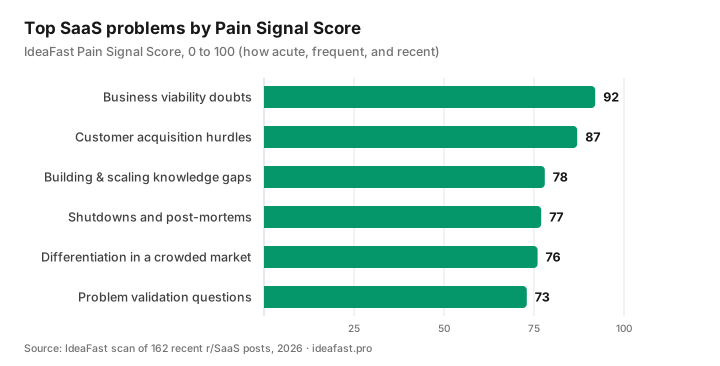
| Problem | The struggle | Pain Signal Score |
|---|---|---|
| Business viability doubts | Is this even a real business | 92 |
| Customer acquisition hurdles | Built it, can't get users | 87 |
| Building & scaling knowledge gaps | What comes after the MVP | 78 |
| Shutdowns and post-mortems | Learning from what failed | 77 |
| Differentiation | Standing out in a crowded market | 76 |
| Problem validation | Is anyone solving a real need | 73 |
1. You can build it. You can't get customers.
The number one struggle on r/SaaS is distribution. Founders ship a working product, get a few free users, and then hit a wall. Building turned out to be the easy part.
Built the product. Got free users. Now stuck on distribution.
I analyzed 500 Product Hunt SaaS launches. 487 are dead.
A launch is not distribution. The market is crowded, attention is scarce, and getting in front of the right people is a job that starts the day you ship, not the day you finish. It also has a real price: knowing your customer acquisition cost early tells you whether the channel you are betting on can ever pay for itself.
2. "Am I even solving a real problem?"
Right behind distribution is doubt. Founders are unsure whether anyone actually needs what they built, and they are often asking the question after they have already built it.
am i solving a real problem or am i building something nobody needs?
This is the most important question on the list, and the cheapest one to answer before you write any code. It is also exactly what sends people to Reddit in the first place: they want proof that the pain is real and that someone will pay to make it go away.
3. The AI-app gold rush is flopping (boring B2B is winning)
A clear 2026 pattern: founders who chased the AI-app trend are posting losses, while people solving dull, specific problems are quietly profitable.
Mass-produced AI apps for 14 months. Made $2,847 total. My friend sells pool cleaning services and cleared $94K.
I quit my job to build an AI SaaS. It flopped. The "boring" backup idea is now making me more in a month than I used to make in a year.
90% of you are failing because you build B2C apps instead of boring B2B tools.
The lesson founders keep relearning: a trend is not a problem. People pay to fix a specific, painful job, not to use whatever technology is fashionable this year.
4. Building costs more than the code
Founders keep finding out the expensive way that code is the cheap part. The real costs are everything around it: design, support, marketing, and the months spent building the wrong thing.
I wasted $50k because I thought the code was the expensive part.
The MVP myth is destroying good products.
The cheapest way to avoid this cost is to validate the problem before you invest the months. The build is rarely what sinks a SaaS.
5. Standing out keeps getting harder
Differentiation is a recurring worry. With so many near-identical tools, founders are unsure what actually makes a buyer pick one over another anymore.
Has the SaaS feature matrix begun to seem less useful?
When features reach parity, positioning does the heavy lifting. Who exactly it is for, and which specific problem it kills, matters more than the feature list.
6. The honest post-mortems
Some of the most valuable threads on r/SaaS are the shutdowns. Founders write up exactly where the money and time went, and the comments turn it into a free education.
Shut down my SaaS after 3 years. Here's the honest accounting of where all the money went.
Customer cancelled after 18 months. Reason: "We built it ourselves."
Read these before you start, not after. The patterns in a good post-mortem will save you a year.
7. AI is creating new problems too
AI is not only a trend that flopped for some. Teams that leaned on it too hard are reporting fresh pain: quality drops and runaway costs.
The AI replaced half our QA team. Then we had the buggiest quarter in company history.
Our token cost optimization setup after the AI budget nearly killed our runway.
SaaS developers are shipping AI-generated code without any QA. Then wondering why users churn in 7 days.
Useful tools, but not free lunches. The founders who win with AI treat it as one more thing to manage, not a replacement for judgment.
8. Just getting the first ten users
Even before scale, the very first users are hard. A large share of posts are simply founders asking how to get anyone at all to try the thing.
What is the best way to get early users?
The answer is almost always the same: go where your users already complain, and talk to them. Which, conveniently, is Reddit.
9. Getting signups is not the same as getting paid
A quieter, more specific version of the acquisition problem shows up once founders clear the first hurdle: people do sign up, and still will not pay. That gap between interest and revenue is its own distinct pain, separate from getting nobody to try the product at all.
My product is basically done and working, and I have zero paying customers. What actually moved the needle for you?
I can get signups but I can't get people to pay
Free signups are cheap proof of curiosity, not proof of a real pain point. If people will not pay after trying it, the more useful question is not "how do I get more signups" but "is the problem this solves actually costing them something," because if it were, they would already be paying to make it stop.
What this list tells you before you build
Look at the top of the list again. Almost every major SaaS problem is downstream of two things: building something people did not clearly need, and not knowing how to reach the people who do. Both are validation problems, and both are far cheaper to solve before you write a line of code.
That is the whole reason we built IdeaFast. Instead of guessing, you point it at a subreddit and it turns the noise into scored, evidence-backed pain points, so you build for a problem people are already complaining about. You can see the live, scored version of this r/SaaS research, refreshed from new Reddit data.
The honest takeaway
SaaS is not dead. It is just harder to coast on. The founders doing well are not the ones with the fanciest stack. They are the ones who picked a real, specific problem and learned how to reach the people who have it.
Read the threads. The pattern repeats. Validate first, then build, and almost everything downstream gets easier.
Frequently asked questions
What are the most common SaaS problems founders face?
Based on 162 recent r/SaaS posts, the most common SaaS problems are getting customers after building, knowing whether the idea solves a real need, differentiation in a crowded market, costs that go far beyond the code, and the emotional weight of shutdowns. The single biggest one is distribution: founders can build the product but cannot get users.
Why do most SaaS startups fail?
The most-cited reason is no market need, around 42 percent according to CB Insights' analysis of startup post-mortems. On r/SaaS this shows up as founders building first and only later asking whether anyone actually wanted it. Weak positioning, poor distribution, and premature scaling are close behind.
Is the SaaS market too saturated in 2026?
Crowded, not closed. Generic and me-too products struggle, and trend-chasing AI apps have been flopping in particular. Specific, painful, often boring B2B problems still make money. The opportunity moved from novel technology to solving a clear problem better than the alternatives.
Where do SaaS founders discuss problems online?
The main hub is the r/SaaS subreddit, with related discussion in r/startups, r/Entrepreneur, and r/indiehackers. Reddit tends to be more candid than anywhere else because founders post real revenue numbers and honest failure stories.
How did you find these SaaS problems?
We scanned 162 recent posts from r/SaaS, used an embedding and clustering pipeline to group posts describing the same struggle, and scored each group by frequency, intensity, and recency. Every quote links back to the original thread so anyone can verify it.
How do I get my first SaaS customers?
Go where your target users already complain and talk to them directly, before and after you build. Distribution is a job that starts the day you ship, not the day you finish. On r/SaaS, 'built the product, now stuck on distribution' is one of the most common posts there is.
Is it too late to start a SaaS in 2026?
No. The market is crowded, not closed. Generic and trend-chasing products struggle, but specific, painful, often boring B2B problems still pay. The opportunity moved from novel technology to solving a clear problem better than the current alternatives.
Skip the manual digging
IdeaFast (ideafast.pro) checks the problem behind a startup idea against Reddit: it finds what people keep complaining about, scores each problem 0 to 100 and links every one to its threads. Pay once, no subscription. First scan free.
Start your free scan