Guide
Customer Pain Points: Types, Examples, How to Find Them
What customer pain points are, the four main types, and 20 real scored examples from Reddit with the threads to prove them.
By Shubham Bhatt · July 16, 2026 · 12 min read · Updated July 24, 2026
Quick answer
Customer pain points are the specific, recurring problems your customers experience that they would pay to solve. They fall into four types: financial (costs and hidden fees), productivity (wasted time and effort), process (friction in getting something done), and support (poor or missing help). The best way to find them is to read where your customers already complain.
IdeaFast reads a community’s recent posts and ranks the problems that keep coming up, with a link to every thread. Point it at your own niche. Your first scan is free.
Scan your nicheMost advice on customer pain points stops at the definition. This one includes real examples, each linked to the actual complaint it came from, plus the practical method for finding your own customers' pain rather than guessing at it.
What is a customer pain point?
A customer pain point is a specific problem a customer keeps running into, one annoying or costly enough that they would pay to make it go away. The key words are specific and recurring. A vague dissatisfaction is not a pain point. A concrete problem that shows up again and again, from many different people, with a real cost attached, is. That last part is what separates a pain point worth building for from a passing complaint.
39
Customer pain points are not rare, they are everywhere and specific. We have scored real customer pain points across 39 different business communities on Reddit, more than 500 in total, each linked to the complaint it came from.
Complaint or pain point? The test that separates them
Not every gripe you read on Reddit is a pain point, and treating them the same is how founders end up building for a problem that does not exist. A complaint can be a one-off, a bad day, or a single person's mood. A pain point has to pass a three-part test before it is worth building for.
- It repeats. The same specific problem shows up from many different people, not one loud thread.
- It costs something. Time, money, or a workaround they already pay for. Vague dissatisfaction with no attached cost is not a pain point.
- It is specific. "Shopify is annoying" is a mood. "Chargebacks reversed 450 days after the sale, with no recourse" is a pain point.
Run any Reddit thread through those three questions before you take it as a signal. Most of what looks like a business idea on social media fails the first one: it is one person, one bad week, not a pattern.
What are the four types of customer pain points?
Most customer pain points fall into one of four categories. Knowing which type you are looking at tells you how to position a solution. Here is each, with a real example from Reddit.
1. Financial pain points
The customer is losing money, paying too much, or hit with costs they did not expect. These are the most urgent, because the pain is measured directly in currency. A live example from r/shopify, where chargebacks are a recurring financial nightmare for merchants:
$2700 Chargeback Opened 450 Days Later for a second time. Shopify doesn't care.
2. Productivity pain points
The customer is wasting time or effort on something that should be faster or automatic. These convert well because the pain is felt daily. From r/socialmedia, managers hunting for tools to stop doing repetitive work by hand:
Best DM automation tools?
3. Process pain points
The way the customer has to do something is clunky, confusing, or broken. Often they do not have the words for it, they just know a workflow is painful. From r/CRM, where choosing and using the right system is a recurring process headache:
CRM Research and Opportunity.
4. Support pain points
The customer cannot get help when something goes wrong, or feels ignored by the company they are paying. These are trust-killers, and they show up loudly. From r/Etsy, a seller feeling unprotected against a scam:
Customer scamming a full refund or negative review.
20 real customer pain points, by type
One example per type only shows you the shape. Here are 20 more, pulled from our scans across 20 different business communities, each scored on our 0 to 100 Pain Signal Score and sorted into the type it fits. Every row traces back to a real thread.
| Type | Pain point | Community | Pain Signal Score |
|---|---|---|---|
| Financial | Chargebacks and refund disputes | r/shopify | 92 |
| Financial | Runaway ad click costs | r/PPC | 91 |
| Financial | Counterfeit products undercutting sales | r/ecommerce | 92 |
| Financial | Clients who ghost after the work is done | r/freelance | 89 |
| Financial | Doubting whether the shop still pays off | r/Etsy | 88 |
| Productivity | Hunting for a social automation tool that works | r/socialmedia | 92 |
| Productivity | Keeping an AI-built app running after launch | r/nocode | 92 |
| Productivity | Not knowing what comes after the MVP | r/SaaS | 78 |
| Productivity | Assembling client reports by hand | r/PPC | 74 |
| Productivity | Chasing clients who went quiet | r/freelance | 71 |
| Process | A CRM that fights how the team actually sells | r/CRM | 92 |
| Process | Sales and marketing talking past each other | r/marketing | 92 |
| Process | "Crawled, not indexed" with no clear reason | r/SEO | 88 |
| Process | Orders cancelled with no clear explanation | r/Etsy | 83 |
| Process | Justifying a price against a cheap lookalike tool | r/growmybusiness | 92 |
| Support | Feeling unprotected against a refund scam | r/Etsy | 92 |
| Support | A payout held with no clear timeline | r/shopify | 60 |
| Support | Ad account verification stuck for weeks | r/PPC | 84 |
| Support | A "client" that turns out to be a scam | r/freelance | 86 |
| Support | Feeling powerless against a platform's own pricing | r/PPC | 76 |
6 of 9
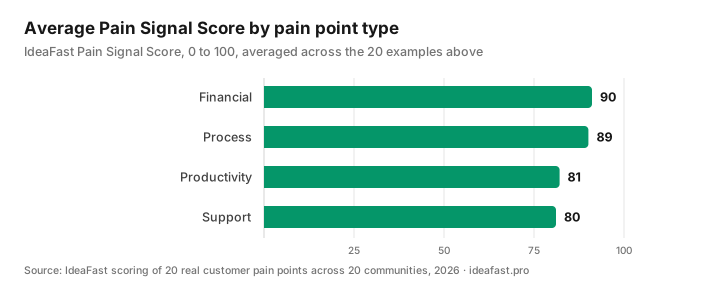
Of the 20 real pain points above, 9 scored 90 or higher on our Pain Signal Score. Two-thirds of those, 6 of 9, were financial or process pain points, not the softer productivity or support kind.
Why financial and process pain points win
Financial pain points score highest because the cost is undeniable. Nobody has to be convinced that a $2,700 chargeback matters. Process pain points score almost as high for a different reason: they are structural. A CRM that fights how a team actually sells, or a workflow that generates the same complaint from person after person, does not go away on its own. It keeps generating the same pain until something changes it.
Productivity and support pain points still matter, and some of the individual examples above score just as high. But on average, they are more likely to be worked around than fixed outright, which is why they land lower. If you are choosing between two ideas and everything else is equal, the financial or process problem is usually the safer bet.
How do you find your customers' pain points?
You do not find real pain points in a meeting room. You find them where customers already talk without being asked: reviews, support tickets, sales-call notes, and above all the online communities where they vent. Reddit is one of the best sources because people there are candid and unprompted. The method is simple to describe and takes practice to do well:
- 1Find the communities where your specific customers gather. Narrow beats broad.
- 2Read for the recurring complaint, not the loudest single post. One angry thread is a data point; the same problem from many people is a pain point.
- 3Note the cost. The strongest pain points come with a mention of time or money already being spent on a workaround.
- 4Capture their exact words. The language customers use becomes the language that sells the solution.
Find the right communities, not the biggest ones
A subreddit with 2 million members is not automatically better than one with 20,000. What matters is whether the people posting there are actually your customer. r/Etsy has real sellers describing real chargebacks and shipping problems. A generic r/smallbusiness thread might have the same person once and then never again. Narrow and specific beats large and general every time.
Read for the pattern, not the loudest post
One furious thread with 400 upvotes feels like a signal, but it might just be one bad experience that resonated for a day. The real pattern shows up across weeks and different people using different words for the same underlying problem. Search the subreddit for the same topic over a few months before deciding it is worth building around.
Look for the cost they are already paying
The strongest pain points come with proof that someone is already spending time or money on a workaround. That could be a spreadsheet they built themselves, a freelancer they hired to patch the gap, or a competitor's tool they are unhappy with but still paying for. If nobody has bothered to work around the problem yet, it may not be painful enough to pay to solve.
Write down their exact words
When you eventually write copy for the product, the words that convert are the words the customer already used to describe the problem, not the words you would choose as a founder. Keep a running list of the exact phrases people use in these threads. That list becomes your landing page headline before you have written a single line of marketing copy.
The full walkthrough is in how to do startup market research on Reddit, and the harder skill of judging a real pattern is in how to analyze Reddit data. To start, find the communities where your customers gather:
Try it now
Find where your customers voice their pain
Type your niche and get the subreddits where that audience complains, with links to real scored pain points where we have researched them.
If you would rather skip the manual reading, browse the pain points we have already scored: more than 500 across 39 communities, each ranked by how strong the signal is and linked to the original thread, so you can see real customer pain points with the receipts attached.
Frequently asked questions
What is an example of a customer pain point?
A concrete one: Shopify merchants repeatedly hit with chargebacks months after a sale, losing money with little recourse. It is specific (chargebacks), recurring (many merchants report it), and costly (real dollars), which is what makes it a genuine pain point rather than a vague complaint.
What are the four types of customer pain points?
Financial (costs, fees, lost money), productivity (wasted time and effort), process (clunky or broken workflows), and support (poor or missing help). Most real pain points fit one of these, and the type tells you how to position a solution.
How do I identify customer pain points?
Read where your customers already talk unprompted: reviews, support tickets, and the online communities where they vent. Look for the same specific problem described by many different people, ideally with a mention of time or money spent on a workaround. Capture their exact words.
What is the difference between a pain point and a complaint?
A complaint can be a one-off or a mood. A pain point is a specific problem that recurs across many different people and carries a real cost. Every pain point started as complaints; it becomes a pain point when you see the pattern repeat.
Why are customer pain points important?
Because a business that solves a real, recurring, costly pain point has built-in demand. Building without a validated pain point is the most common reason products fail: the thing works, but nobody needed it badly enough to pay.
Where can I find real customer pain points to research?
Online communities where your customers gather are the richest source. We publish more than 500 scored customer pain points across 39 business communities, each linked to the original Reddit thread, so you can study real examples with the evidence attached rather than made-up ones.
Which type of pain point is worth building for first?
Financial and process pain points score highest on average (90 and 89 out of 100 in our data, versus 81 for productivity and 80 for support). The cost is undeniable and the problem is structural, so it keeps recurring until something fixes it. That said, the strongest individual example in any category beats an average one in a 'better' category.
Skip the manual digging
IdeaFast (ideafast.pro) checks the problem behind a startup idea against Reddit: it finds what people keep complaining about, scores each problem 0 to 100 and links every one to its threads. Pay once, no subscription. First scan free.
Start your free scan