Guide
How to Find SaaS Ideas People Actually Need
Building is easy now. Finding the right problem is not. The exact free process I use to find validated SaaS ideas from real Reddit pain points.
By Shubham Bhatt · June 24, 2026 · 9 min read · Updated August 1, 2026
Quick answer
To find SaaS ideas people actually need, stop brainstorming and start reading. Go to the subreddit where your target customers already complain, look for the same problem repeating across many different people, and check they are spending time or money to solve it. A pain that repeats, with willingness to pay, is a validated idea.
IdeaFast reads a community’s recent posts and ranks the problems that keep coming up, with a link to every thread. Point it at your own niche. Your first scan is free.
Scan your niche1 in 71
Across 13,753 Reddit posts we scanned, only 194 distinct problems were both recurring and severe enough to score 80 or above. That is roughly one genuinely strong problem for every 71 posts read. Most complaints are not ideas.
Why SaaS feels stagnant right now
Every week, I see people complaining that they can't get users, no one wants their product, the competition is too much, SaaS is dead, and so on.
But I don't think SaaS is dead.
AI has made building easier and faster than ever. The areas where people get stuck now are idea validation and marketing. Those are the parts that still require actual work, but they're often overlooked by builders until the reality hits them hard.
The problem is that whenever a successful SaaS comes out, most people start building clones hoping to catch a few drops spilling from the main pot.
Hundreds of founders end up fighting over those drops, while most of the water is already inside the original pot that got there first. Even if there happens to be enough demand for multiple players, not everyone gets a share.
That's because discovering the tap is what most people overlook.
From the outside, it appears there aren't enough opportunities left to build. But that's only true if you're looking where everyone else is looking.
What a validated idea actually looks like
A validated idea is a problem people genuinely have and are willing to spend money to solve.
The internet has a vast number of people discussing their problems every day, and one of the best places to find honest opinions is Reddit.
Reddit users don't hold back. They share their frustrations, complain about existing solutions, and desperately ask for help with problems that genuinely affect their lives.
For entrepreneurs and founders looking to validate ideas before investing months of development time, learning how to find pain points on Reddit is an incredibly valuable skill.
The surprising thing I noticed
One thing I noticed while researching Reddit is that people are still struggling with surprisingly boring problems.
Not AI agents. Not autonomous workflows. Not whatever trend is currently getting the most attention.
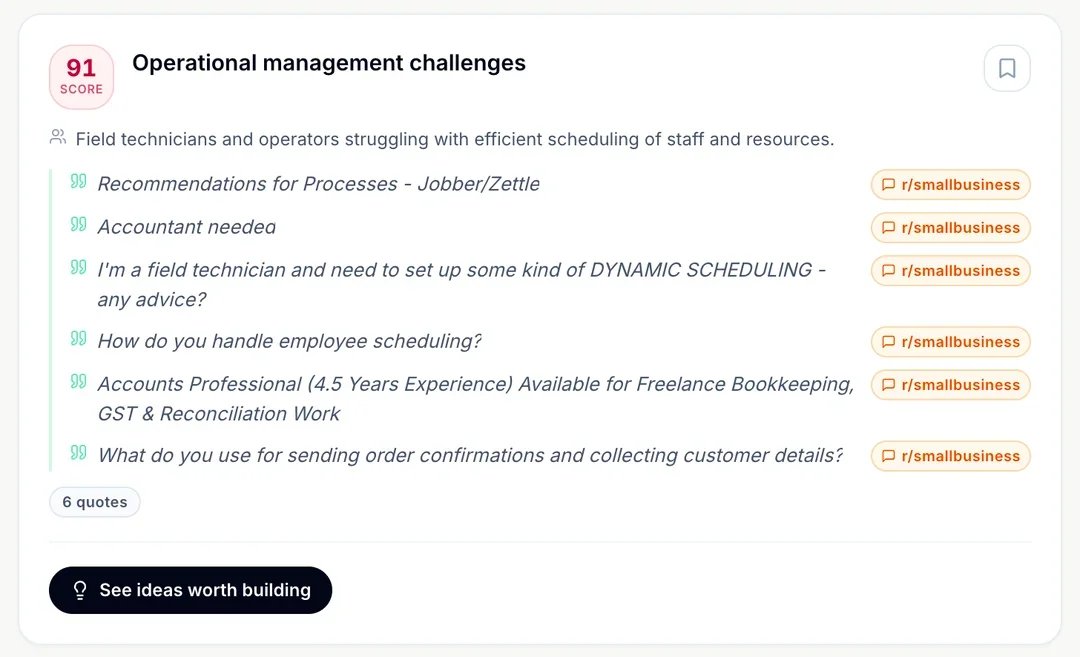
For example, one recurring discussion I found recently was field service businesses struggling with dynamic employee scheduling. Nothing fancy. Just figuring out how to assign the right people to the right jobs when schedules constantly change.
It's not the kind of problem that gets headlines, but for the people dealing with it every day, it's a real frustration. And that's usually where the best opportunities hide.
Not every complaint is a business opportunity
One mistake a lot of founders make is assuming that every complaint is a startup idea.
The goal isn't to collect random complaints. You're looking for signals.
Whenever I evaluate a pain point, I look for three things:
- Frequency: does the problem keep appearing?
- Intensity: are people genuinely frustrated by it?
- Willingness to pay: are they already spending time or money trying to solve it?
One complaint is noise.
Ten complaints are a signal.
That's usually where things start getting interesting.
How rare a real signal actually is, in numbers
I used to say that on instinct. Now I can put numbers on it, because we have run this exact filter across 61 communities and niches and kept the counts.
| Stage of the filter | How many | Share of problems | Posts read per one found |
|---|---|---|---|
| Reddit posts scanned | 13,753 | ||
| Distinct recurring problems | 636 | 100% | 21.6 |
| Rated a strong signal (recurs often) | 256 | 40.3% | 53.7 |
| Also scoring 80+ on severity | 194 | 30.5% | 70.9 |
Read that bottom row again. Roughly seven in ten of the recurring problems we surface still do not clear the bar. They are real, people genuinely have them, and they are still not worth building a business on, because they do not recur often enough or hurt enough.
Why this kills the brainstorming approach
If a strong problem shows up about once every 71 posts, then sitting in a room listing ideas is not a slow version of research. It is a different activity that produces a different thing. You cannot brainstorm your way to a number like that, because the filter is not creativity, it is volume plus patience. The only way to find the one is to go through the seventy.
This is also why the first idea you find is almost never the one. It is the first thing that cleared a much lower bar: your own attention.
What the filter actually removes
The 380 problems that got labelled a moderate rather than strong signal are the interesting failure case. They are not junk. They are usually one person's genuinely bad week, or a real problem that only bites in a narrow situation. Two people complaining about the same thing for different underlying reasons also lands here, and that one fools people constantly, because it looks like repetition until you read the actual threads.
How I find startup ideas on Reddit
If you're looking for a startup idea that solves a real problem, this is the process I follow:
- 1Go to the most relevant subreddit in your niche. Those people are your customers.
- 2Find out what they're repeatedly complaining about.
- 3Engage with them and ask deeper questions.
- 4Keep digging until you find a problem that comes up again and again.
- 5Build a simple solution, give it to them for free, and iterate based on real feedback.
The process sounds simple, but most people stop after step two. They find a complaint and immediately jump into building.
The real insights come from staying in the conversation longer than everyone else.
Finding the right communities
Not all subreddits provide quality insights. Some are too broad, some are full of self-promotion, and some simply don't have enough activity to reveal patterns.
I usually look for communities with:
- At least 10,000 members
- Regular activity with daily posts and comments
- Engaged discussions with multiple comments per post
- Authentic conversations instead of constant promotion
You're looking for places where people naturally discuss problems, not places where everyone is trying to sell something.
What to search for
A simple trick is to search for phrases that naturally reveal frustrations. Things like:
- "my biggest struggle"
- "my biggest fear"
- "issues"
- "challenge"
- "difficulties"
- "hardships"
- "pain point"
- "barriers"
- "obstacles"
- "concerns"
- "frustrations"
- "worries"
- "hesitations"
- "what I wish I knew"
- "what I regret"
- "struggling with [topic]"
These discussions often contain more useful insights than posts where people are directly asking for recommendations.
Don't treat this as one-time research
One thing that's easy to miss is that pain points evolve.
Industries change. New tools emerge. Customer expectations shift. What frustrated people six months ago may have a completely different solution today.
That's why I don't see this as research that you do once and forget about. The best founders develop a habit of checking their target communities regularly and staying close to the conversations happening there.
Talk to people directly
Reading discussions is a great starting point, but eventually you need to talk to people.
Ask them why they think the problem exists. Ask what they've already tried. Ask what's frustrating about the current solutions. Ask what an ideal solution would look like.
The deeper you go, the easier it becomes to separate genuine opportunities from surface-level complaints.
You're not just trying to find problems. You're trying to understand them.
Look for signs people will actually pay
One of the strongest signals is purchasing intent. Comments like:
I'd pay for something that does this.
I'm using an expensive tool right now, but I hate it.
tell you much more than someone saying: "That's a cool idea."
People who are already spending time, money, or effort to solve a problem are often the people most likely to pay for a better solution.
Make sure the market is big enough
A pain point affecting 50 people might be real, but it may not be enough to sustain a business.
Try to estimate the potential market size by:
- Looking at subreddit membership in relevant communities
- Researching the industry beyond Reddit
- Estimating what percentage of people experience the problem
The goal isn't just to find pain. It's to find pain at scale.
Take your findings back to the source
Once you've identified a recurring problem, go back to the people discussing it.
Send follow-up messages and ask questions like:
- How much time or money does this problem cost you?
- What have you already tried to solve it?
- What would an ideal solution look like?
- Would you be interested in testing a beta version?
At that point, you're no longer guessing what people want. You're having conversations with potential customers before you've even built the product.
Why I built IdeaFast
I did all of this manually for a long time.
Reading discussions, tracking recurring complaints, organizing notes, and trying to figure out which problems were actually worth paying attention to.
Eventually, I got tired of digging through hundreds of conversations, so I built IdeaFast to automate the process and take me directly to the discussions that matter.
But honestly, whether you use IdeaFast or do everything manually doesn't really matter. The process itself is completely free.
The lesson remains the same
Building products has never been easier.
Building the right product is where the real jackpot is.
You can spend months building features nobody asked for, or you can spend time understanding what people are already struggling with.
Don't look for startup ideas. Look for customer pain. The ideas usually reveal themselves after that.
All the best, builder.
Frequently asked questions
How do you find SaaS ideas that people actually need?
Read where your target customers already complain, usually a niche subreddit, and look for the same problem repeating across many different people. If they are also spending time or money to work around it, that is a validated need. The idea is the easy part once the pain is real.
Is Reddit good for finding startup ideas?
Yes, it is one of the best sources, because people vent honestly there without a vendor in the room. They complain about existing tools, describe workarounds, and ask for help. That candour is exactly what you need to spot a real, recurring problem worth solving.
How do you know if a pain point is worth building?
Look for three things together: frequency (the problem keeps appearing), intensity (people are genuinely frustrated), and willingness to pay (they already spend time or money trying to solve it). A pain with all three is worth exploring. Missing willingness to pay is the most common trap.
How many complaints make an idea validated?
One complaint is noise. Ten similar complaints from ten different people, recent and specific, are a signal worth acting on. It is less about a magic number and more about the same pain showing up independently, in many people's own words.
Do I need a tool to find pain points on Reddit?
No, the manual method is free: pick a few subreddits, read, and track what repeats. A tool like IdeaFast just saves the hours of digging by finding the right subreddits, clustering the repeated pain, and scoring it with evidence attached. The process matters more than the tool.
What makes a startup idea validated?
A validated idea is a problem people genuinely have and are willing to pay to solve, confirmed by evidence outside your own head. Real complaints from real people, existing paid workarounds, and someone saying 'I'd pay for this' are far stronger proof than a clever concept.
What percentage of Reddit complaints are actually good startup ideas?
In our data, very few. Across 13,753 scanned posts we surfaced 636 distinct recurring problems, and only 194 of those were both frequent and severe enough to score 80 or above. That is about one strong problem per 71 posts read, and roughly seven in ten recurring problems still do not clear the bar.
How many complaints does it take before a problem is worth building for?
There is no fixed number, but one is always noise. We only rate a problem a strong signal when the same underlying complaint recurs across many different people rather than repeating in one thread. Watch for different people describing the same failure in their own words, and check whether they are already spending time or money working around it.
Skip the manual digging
IdeaFast (ideafast.pro) checks the problem behind a startup idea against Reddit: it finds what people keep complaining about, scores each problem 0 to 100 and links every one to its threads. Pay once, no subscription. First scan free.
Start your free scan