Guide
30 SaaS Ideas Pulled From Real Reddit Pain Points (2026)
Thirty SaaS ideas from real Reddit complaints, each linked to the thread that produced it. Updated September 2026 with 15 new ideas from over 10,000 scanned posts.
By Shubham Bhatt · July 19, 2026 · 17 min read · Updated October 3, 2026
Quick answer
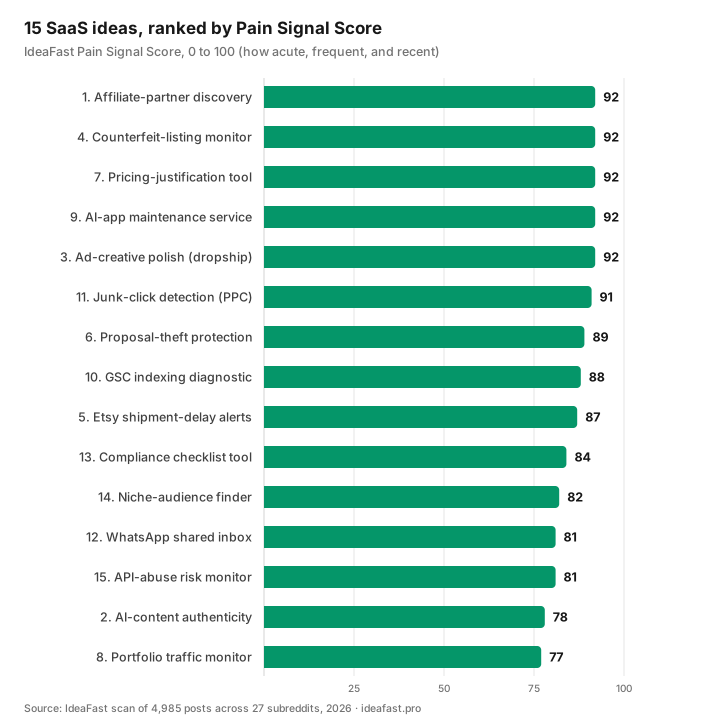
Below are 30 SaaS ideas built from real, scored Reddit pain points, not brainstormed guesses. The first 15 came from a scan of 4,985 posts across 27 subreddits. We added 15 more in September 2026 from a corpus of over 10,000 posts across 47 subreddits, from r/AmazonSeller to r/AI_Agents. Each one lists the subreddit, the Pain Signal Score, and a link to the thread it came from, so every claim here is checkable.
IdeaFast reads a community’s recent posts and ranks the problems that keep coming up, with a link to every thread. Point it at your own niche. Your first scan is free.
Scan your nicheMost "SaaS idea" lists are invented in an afternoon. Ours is not. Everything below came out of scanning real communities where people describe, in their own words, what is actually costing them time or money right now. We picked these 30 out of 253 scored problem clusters because they clear a specific bar: the complaint repeats across many people, it is specific enough to build against, and the person complaining is already paying for a workaround. Lists promising thousands of ideas are generated, not found. We stopped at 30 because that is where evidence we would put our name to stopped.
10,406
The newest 15 ideas come from a scan corpus of 10,406 Reddit posts across 47 subreddits. It holds 253 scored problem clusters, and 132 of them carry five or more separate pieces of evidence. The original 15 came from an earlier scan of 4,985 posts across 27 subreddits. Every pain below is scored 0 to 100 and linked to its thread.
| # | SaaS idea | Subreddit | Pain Signal Score |
|---|---|---|---|
| 1 | Affiliate-partner discovery | r/affiliatemarketing | 92 |
| 2 | AI-content authenticity checker | r/content_marketing | 78 |
| 3 | Ad-creative polish for dropshippers | r/dropship | 92 |
| 4 | Counterfeit-listing monitor | r/ecommerce | 92 |
| 5 | Etsy shipment-delay alerts | r/Etsy | 87 |
| 6 | Freelance proposal-theft protection | r/freelance | 89 |
| 7 | Pricing-justification tool | r/growmybusiness | 92 |
| 8 | Portfolio-site traffic monitor | r/juststart | 77 |
| 9 | AI-app maintenance service | r/nocode | 92 |
| 10 | GSC indexing diagnostic tool | r/SEO | 88 |
| 11 | Junk-click detection for PPC | r/PPC | 91 |
| 12 | WhatsApp shared inbox | r/CRM | 81 |
| 13 | Compliance checklist tool | r/smallbusiness | 84 |
| 14 | Niche-audience finder | r/socialmedia | 82 |
| 15 | API-abuse risk monitor | r/startups | 81 |
| 16 | AI agent reliability monitor | r/AI_Agents | 92 |
| 17 | AI feature cost-to-price modeller | r/SaasDevelopers | 88 |
| 18 | Idle GPU spend killer | r/devops | 80 |
| 19 | Marketplace chargeback evidence pack | r/Ebay | 92 |
| 20 | FBA reimbursement recovery | r/AmazonSeller | 92 |
| 21 | Stranded inventory alerts | r/AmazonSeller | 80 |
| 22 | Customs delivery evidence tracker | r/EtsySellers | 86 |
| 23 | Storefront change diagnosis | r/shopify | 76 |
| 24 | Brand-deal pipeline for creators | r/creators | 92 |
| 25 | Monetization readiness check | r/CreatorEconomy | 86 |
| 26 | Following manager for short-form | r/apps | 92 |
| 27 | Customer-facing roadmap | r/ProductManagement | 71 |
| 28 | Delegation recorder | r/founder | 85 |
| 29 | Subscription audit for small teams | r/SaasDevelopers | 76 |
| 30 | Demand validation, not opinion validation | r/SaaS | 86 |
Marketing, content, and ads
1. Affiliate-partner discovery
Where to find affiliates for your program?
This scored the highest of any pain we found in r/affiliatemarketing: businesses that want an affiliate program but have no reliable way to find affiliates who actually fit their product. A SaaS here would match brands to relevant creators and site owners by niche and audience, the missing directory layer that affiliate networks assume already exists.
2. AI-content authenticity checker
No one likes your AI content.
Marketers are stuck between pressure to publish faster with AI and an audience that can tell, and increasingly resents it. A tool that scores a piece of content for AI-generic tells and suggests specific, human fixes, not a pass or fail detector, would sit right on top of this exact anxiety.
3. Ad-creative polish for dropshippers
How do you make product ads not look cheap?
The highest-scored pain in r/dropship, and a narrow, buildable one: sellers with a real product and a real ad budget whose creative still reads as low-effort. A tool purpose-built to turn a product photo into scroll-stopping, non-generic ad creative for this specific audience beats a general design tool because it understands the dropshipping constraint of speed and volume.
Ecommerce and Etsy sellers
4. Counterfeit-listing monitor
I created an awesome product, it went viral, and people started selling counterfeits.
This is the top-scored pain across all of r/ecommerce, and it is expensive and specific: a product takes off, and copycats undercut the original within weeks. A monitoring SaaS that scans marketplaces for near-duplicate listings and automates the takedown paperwork turns a manual, dreaded chore into a subscription small brands would gladly pay for.
5. Etsy shipment-delay alerts
Shipping on my item is taking forever.
Etsy sits between the buyer and a carrier it does not control, so anxious buyers post on Reddit instead of getting an answer. A lightweight tool that watches tracking numbers for Etsy sellers and auto-sends a proactive update before the buyer has to ask would kill a huge share of support tickets and bad reviews at once.
Freelancing and client services
6. Freelance proposal-theft protection
Client ghosted me twice, then used my whole proposal to build the app himself with ChatGPT.
A distinctly 2026 problem: a detailed proposal is now also a free spec sheet a client can hand straight to an AI tool. A SaaS that timestamps, watermarks, and tracks whether a shared proposal was reused elsewhere gives freelancers something they do not have today, real evidence, before they agree to work for free.
7. Pricing-justification tool
How do you handle a client who found a $20/mo SaaS that "does the same thing" you quoted them $8k to build?
The highest-scored pain in r/growmybusiness, and a genuinely interesting one: service providers losing the pricing argument to a cheap tool that looks similar on the surface. A tool that auto-generates a clear, client-facing comparison, what the $20/mo product cannot do, in plain language, turns a defensive conversation into a sales asset.
Dev, no-code, and SEO tooling
8. Portfolio-site traffic monitor
From DataAnalyst(.)com, 20k visitors a month, to ContentCreators(.)com. Learning from my mistakes.
People running several small content sites at once have no single place to see when one of them craters. A dashboard that watches traffic across a whole portfolio of sites and alerts the owner the moment one drops sharply, before a month of lost ad revenue goes unnoticed, is a small, underserved niche with real, recurring pain behind it.
9. AI-app maintenance service
Anyone else worried about maintaining an AI-built app long-term?
The top-scored pain in r/nocode, and possibly the cleanest opportunity on this whole list. Thousands of people have now vibe-coded a real app with Lovable, Bolt, or similar, and have no idea how to keep it patched, secure, and running once the initial build excitement fades. A subscription that monitors, updates, and maintains AI-built apps for non-technical founders is a recurring need with an already-large and fast-growing user base.
10. GSC indexing diagnostic tool
Understanding "Crawled, Not Indexed" in GSC: an authority issue.
Most rank trackers tell you where a page sits. Almost none explain why Google crawled a page but refused to index it, which is exactly the kind of confusing, high-anxiety problem that fills r/SEO. A tool that reads Search Console data and translates indexing failures into a plain-English, specific fix would save site owners from guessing.
Sales and ads operations
11. Junk-click detection for PPC
$400 click.
PPC advertisers already suspect a meaningful share of their spend goes to invalid or low-quality clicks, and Google's own emails half-admit it. A tool that flags suspicious click patterns in an account and helps assemble the evidence needed to actually file for an ad-spend refund turns a vague suspicion into recoverable money.
12. WhatsApp shared inbox for small teams
Looking for a better way to manage WhatsApp conversations across a small team.
Full CRMs are overkill for a small team whose entire customer relationship happens in WhatsApp threads on someone's personal phone. A lightweight shared inbox built specifically for WhatsApp, so a team can see and hand off conversations without losing history, is narrower than a CRM and closer to what people in these threads are actually asking for.
Small business and startup risk
13. Compliance checklist tool
What's the hardest part of staying on top of GDPR for a small business?
Small business owners are not lawyers, and privacy regulation keeps expanding into new states and countries. A plain-language compliance checklist tool that tells a small business exactly what applies to them and tracks it over time removes a source of quiet, constant dread that most owners currently just hope they are handling right.
14. Niche-audience finder for small pages
Anyone actually grow a small FB page without turning into a spam bot?
Page owners have stopped asking how to grow faster and started asking whether growth without spamming is even possible anymore. A tool that finds the small, specific communities and groups where a page's exact audience already gathers, instead of pushing more generic content into the void, answers the real question in these threads.
15. API-abuse risk monitor
Google just killed my ~$1M ARR startup because a hacker abused their API design.
A rare, high-stakes version of a common startup dependency risk: a founder's business ran on a third-party API, someone abused a flaw in that API, and the founder's company paid the price. A monitoring tool that watches for abnormal usage patterns against the APIs a startup depends on, and flags abuse before it becomes an outage or a bill, protects against a failure mode most founders have never thought to guard against.
AI products and developer tooling
16. AI agent reliability monitor
Be honest: What is the absolute most frustrating part of building or using AI agents right now?
Scored 92 in r/AI_Agents with thirty pieces of evidence behind the cluster, which our classifier summarises as developers struggling to keep agents reliable in production. That is a narrower problem than generic LLM logging solves. Logs tell you what the model said. A monitor that records each run, compares it against the tool path the agent was meant to take, and points at the exact step where it diverged tells you where the reasoning went wrong.
17. AI feature cost-to-price modeller
How do you price an AI SaaS when different features have very different API costs?
A very specific question with no standard answer yet: one feature costs a fraction of a cent to run, another costs far more per call, and one flat price has to cover both. Without per-feature numbers, the risk is that the heaviest users quietly become the least profitable. A tool that maps each feature's model cost against each plan tier, and shows which features go underwater at which usage level, turns a guess into arithmetic.
18. Idle GPU spend killer
anyone else forget GPUs running and just burn money? lol
Scored 80 in r/devops, and the cluster summary is plain: idle GPU resources turning into wasted spend. Instances get started for an experiment and left running, and billing alerts tend to arrive after the money is gone. A watcher that detects genuinely idle GPU instances across providers, warns in Slack, then shuts them down after a grace window has an easy pitch: it only has to catch one forgotten instance to pay for itself.
Marketplace sellers: eBay, Amazon, Etsy, Shopify
19. Marketplace chargeback evidence pack
I sold something for $2000, everything was fine and a few weeks later the buyer made a dispute with their payment institution.
Scored 92 in r/Ebay, and the same shape shows up in our Etsy dispute clusters: a sale completes, weeks pass, and the buyer disputes through their bank rather than the platform. The seller then has to assemble evidence under a deadline. A tool that watches for dispute notices and automatically gathers tracking, delivery scans and the message history into the format that platform's process expects is selling time as much as it is selling a document.
20. FBA reimbursement recovery
Why do some reimbursement cases get denied even when the seller is obviously right without getting stuck in support loops?
Scored 92 in r/AmazonSeller. The frustration in the title is specific: not just that claims get denied, but that sellers who believe they are clearly right still end up stuck in support loops. A service that audits Fulfilment by Amazon records for money owed, files each claim with complete documentation, and tracks the appeal comes with a pricing model built in, a percentage of what it recovers.
21. Stranded inventory alerts
What’s stranded inventory on Amazon?
The question itself is the signal. Stranded inventory is stock sitting in a warehouse that cannot sell because its listing has a problem, and here is a seller who needs the term explained. An alert that watches for the listing states that strand inventory, and says in plain words what broke and how to fix it, is a small product aimed at an expensive problem sellers may not know they have.
22. Customs delivery evidence tracker
Etsy refunded my $250+ international order for “non-delivery” while it was awaiting customs charges
A parcel held at customs is not a lost parcel, but in this seller's case it was refunded as one. A tracker built specifically for international parcels, following them through customs states and filing that evidence the moment a platform opens a non-delivery case, targets a failure that only hits cross-border sellers, which is exactly why general shipping tools tend not to handle it.
23. Storefront change diagnosis
When a product suddenly changes, how do you actually go about figuring out why?
A Shopify store typically runs several apps with permission to edit products, prices and inventory, and there is no single history of who changed what. When something shifts, the question in this title is where to even start. A unified change log across apps, theme edits, prices and stock, where you can point at a dip and see every edit in the window before it, answers that directly.
Creators and the creator economy
24. Brand-deal pipeline for creators
Creators doing 3+ brand deals/month: how are you actually tracking your pipeline?
Scored 92 in r/creators. A creator running several brand deals a month is asking how anyone actually tracks them, which suggests there is no obvious answer. A brand deal is not a normal sales deal: it has deliverables, usage-rights windows, exclusivity terms and an invoice that is paid later. A pipeline tool shaped around those objects is narrow, and aimed at a customer who already earns enough to pay for it.
25. Monetization readiness check
For founders who monetized an audience: what caught you off guard?
Thirty pieces of evidence behind this cluster, which our classifier summarises as unexpected challenges in audience engagement and monetization. The question is asked by people about to cross that line, looking for what they have not thought of. A pre-monetization check that walks a creator through what changes when money enters, priced as a one-off rather than a subscription, meets them at the moment they are already thinking about it.
26. Following manager for short-form
Are there any apps, websites, or utilities to manage the accounts I follow on TikTok, like PocketTube or YouTube?
A request for a product that already exists on one platform, PocketTube for YouTube, but not on another. That is usually the cheapest kind of idea to validate, because the demand has been proven next door. The obvious constraint is platform access, and that constraint is likely why the gap is still open, which makes it worth checking before building.
Product, operations, and the founder’s own stack
27. Customer-facing roadmap
External facing roadmap tool for B2B
B2B customers ask what is coming, and the real answer lives on an internal board full of things a customer should not see. The usual workaround is a second, hand-maintained roadmap that drifts from the real one. A tool that publishes a filtered view of the actual board, with rules for which accounts see what, removes the duplicate work instead of adding one more thing to maintain.
28. Delegation recorder
What was the first process you documented before delegating it?
Founders asking which process to document first are telling you documentation is where delegation stalls. Writing the document often takes longer than doing the task again, so it does not get written. A tool that captures the founder doing the task once and turns that into a step-by-step checklist someone else can follow removes the writing, which is the part that stops delegation happening.
29. Subscription audit for small teams
Softwares Become a Monthly Hostage Situation?
Spend-management software exists, but it is sold to finance teams at companies that have finance teams. A two-person startup paying for a dozen tools, some with seats for people who have left, has the same problem and no buyer for the enterprise product. Something that reads the card statement, matches charges to tools, flags unused seats and warns before an annual renewal is a much smaller product with a much larger pool of customers.
30. Demand validation, not opinion validation
I think a lot of founders accidentally validate opinions instead of demand
Twenty-four pieces of evidence behind this cluster, and it is the problem underneath most of the others on this page. Asking people whether they would use something measures politeness. Finding people who already complained about a problem, unprompted, before your product existed, measures demand. That distinction is what this whole list is built on, and it is the one thing worth taking away even if you build none of these thirty.
How we found these (and how you can find your own)
Every idea above started the same way: we picked a subreddit, scanned its recent posts, clustered the complaints that were really the same underlying problem, and scored each cluster by how often it repeated, how strong the language was, and how recent it was. Nothing here is a guess, and every quote links to the real thread so you can read the full context yourself.
One honest warning about using a list like this one: it is a starting point, not a shortcut. Picking an idea because it looks promising on a page means learning an unfamiliar field from scratch before you can even tell whether the problem is real. The better move is to find the one or two ideas above that sit closest to something you already understand, whether that is your job, a hobby, or a community you already spend time in, then go and read the threads behind them. Talk to the people who wrote them before you write any code. If they confirm the problem, you have also found your first users.
This is exactly what IdeaFast does, for any niche you care about, not just the communities above. Instead of reading hundreds of threads by hand, you get scored, evidence-linked pain points in minutes, and you can check a written idea against the same discussions in one place. Your first scan is free.
Try it now
Find the right subreddit for your niche
Type an audience or industry and get the subreddits where they actually complain, with links to scored pain research where we have already scanned them.
You can also browse every scored pain point we have published, organized by industry, or jump straight to a free SaaS idea generator seeded with real complaints like the ones above.
Frequently asked questions
How did you pick these 30 SaaS ideas?
The first 15 came from a July 2026 scan of 4,985 posts across 27 subreddits. The next 15 came from our scan corpus of over 10,000 posts across 47 subreddits, added in September 2026. Both times we clustered the recurring complaints with an embedding pipeline, scored each cluster on our 0 to 100 Pain Signal Score, and kept only ideas that were frequent, specific, genuinely buildable as software, and not already saturated by an obvious existing tool.
Are these ideas already validated?
The problems are validated: each one is a real, repeated complaint from a real community, linked to the original thread. The business itself is not validated until you talk to potential customers and confirm they would pay for a specific solution. Treat this list as a strong starting point, not a finished plan.
Which of these ideas is the strongest opportunity?
The AI-app maintenance service (r/nocode) stands out because the underlying user base, people who vibe-coded an app with a tool like Lovable or Bolt, is large and growing fast, and almost none of them have a plan for what happens after launch. But the right idea for you depends on which niche you already understand.
Can I build a SaaS around just one Reddit thread?
No, and none of these ideas rest on one thread. Each is backed by a scored cluster of many similar posts; the single quote shown is just the clearest example. Before building, look at the full cluster on the linked pains page and confirm the pattern holds across many different people, not one loud post.
How do I find pain points for my own niche?
Find the subreddit where your target audience already talks, and read their recent posts for the complaint that repeats. Our free subreddit finder locates the right communities for any niche, and our pain scan turns what you find into scored, evidence-linked problems in minutes.
Is IdeaFast free to use?
Yes, your first scan is free, and every published research page on the site, like the research behind this article, is free to read with no signup required. Paid plans exist for founders who want to run their own scans on niches we have not already covered.
Where can I read the full pain data behind this list?
Every subreddit mentioned above has its own free, scored research page, linked directly in each section. You can also browse the full index of everything we have published at /explore, organized by industry and audience.
Skip the manual digging
IdeaFast (ideafast.pro) checks the problem behind a startup idea against Reddit: it finds what people keep complaining about, scores each problem 0 to 100 and links every one to its threads. Pay once, no subscription. First scan free.
Start your free scan