Guide
Indie Hacker Pain Points: What Reddit Reveals in 2026
The problems indie hackers actually struggle with, from 600 recent posts. It is getting users, validating and distribution, not building.
By Shubham Bhatt · July 15, 2026 · 9 min read
Quick answer
The biggest indie hacker pain point on Reddit is not building, it is getting users to convert. Across 600 recent posts in indie-hacker communities, the top struggles were turning signups into paying users, validating the idea, deciding what to focus on, and finding leads. Writing the code was rarely the hard part.
IdeaFast reads a community’s recent posts and ranks the problems that keep coming up, with a link to every thread. Point it at your own niche. Your first scan is free.
Scan your nicheIndie hackers are great at shipping. The threads across r/indiehackers, r/SaaS, r/microsaas, r/startups, and r/Entrepreneur show where it goes wrong after that, and the pattern is remarkably consistent. Here is what people actually struggle with, backed by the real posts.
92
Getting users to actually convert to paying scored 92 out of 100 on our Pain Signal Score, the top problem across 600 recent posts in indie-hacker communities, while writing the code was rarely the issue.
What do indie hackers struggle with most?
Almost every top pain we scored is a version of the same story: the product exists, and nobody is paying for it. The problems we found cluster tightly around distribution and validation, not development, ranked here by our Pain Signal Score.
- Getting users to convert (highest score): signups come, paying users do not. The gap between interest and revenue is the loudest pain.
- Validating the idea: builders trying to confirm people actually want the thing, ideally before months of work.
- Deciding what to focus on: should-I-keep-going threads, pivots, and the paralysis of too many directions.
- Finding leads: cold outreach that gets no replies, and no clear idea of who the customer even is.
- Pricing: what to charge, and whether lifetime deals or monthly is the smarter call.
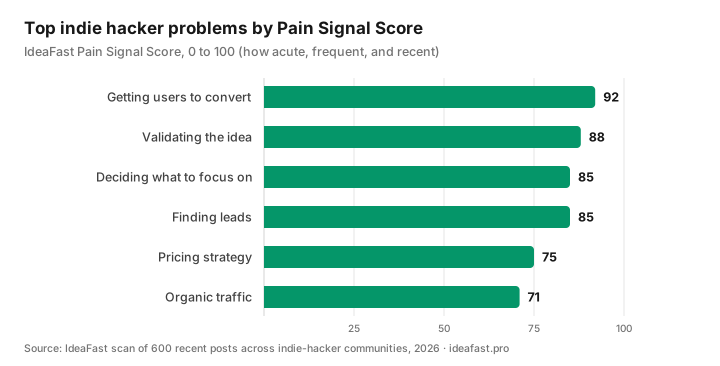
| Problem | The struggle | Pain Signal Score |
|---|---|---|
| Getting users to convert | Signups but no paying users | 92 |
| Validating the idea | Confirming demand before building | 88 |
| Deciding what to focus on | Pivots and should-I-continue | 85 |
| Finding leads | Cold outreach, unclear ICP | 85 |
| Pricing strategy | What to charge, lifetime vs monthly | 75 |
| Organic traffic | Getting found without paid ads | 71 |
Why can't indie hackers get users?
Because building and distribution are different skills, and the culture rewards the first one. The threads are full of technically capable people who shipped something real and then hit a wall. The honesty is what makes them useful:
My first SaaS got 6 signups and 0 paying users after 3 months. What should I do differently next time?
Getting users but not getting paid. How did you improve conversions?
The uncomfortable lesson underneath these is that a lot of the problem starts before any code is written. If you build something without confirming people already want it, no amount of marketing fixes that later. The builders who avoid this pain tend to start from a real, repeated complaint, not a clever idea.
How do indie hackers get their first users?
This is the question the threads circle back to most, and the honest answer in the community is that no channel just works. The people who break through tend to go where their users already are and talk to them directly, often before they have anything polished to show.
Where do/did you get your first/test users?
Cold outreach comes up constantly too, usually paired with the admission that it is not landing. The recurring miss is starting outreach without a sharp idea of who the customer is, so the message reads as generic and gets ignored. Nailing the specific person first is what separates the threads that worked from the ones that did not.
I'm cold mailing b2b companies to find out what problems I can solve for them, and not even getting replies.
Should you keep going or move on?
Deciding what to focus on scored nearly as high as getting users, and it is the quietest pain in the set. These are not launch posts. They are people months in, unsure whether to keep pushing, pivot, or walk away, and asking strangers because they have no one else to ask.
Should I quit and focus on something else?
Anyone given up on startups? What do you do? What do you think about?
There is no tool that answers this cleanly, but the pattern in the threads is telling: the people who move on fastest are usually the ones who never had a clear signal that anyone wanted the thing. Which loops back to the first lesson, that the cost of skipping validation is paid later, in exactly this kind of stuck, drained decision.
How do you avoid building something nobody wants?
Validate the problem before you build the product. That means confirming the same specific pain shows up from many different people, and that they already spend time or money working around it. A fast first check is to gut-check the idea itself: who is it for, what breaks it, and is the problem real.
How to validate a startup idea?
It is worth noticing that validation is itself one of the top-scored pains: people are openly asking how to do it, which means the how is not obvious even to motivated builders. The short version is to confirm the pain before the product, so you never end up in the quit-or-continue thread above.
Try it now
Gut-check your idea before you build it
Paste your idea for a fast read on the audience, the risks, and whether the problem looks real, before you spend a month on it.
Then go deeper: read where your target users gather and confirm the pain repeats. The method is in how to analyze Reddit data for market research, and the scored indie hacker pain points show the full data behind this post, each linked to the original threads.
Frequently asked questions
What is the biggest problem indie hackers face?
Getting users to convert to paying. In our scan of 600 recent posts across indie-hacker communities, it scored highest on our Pain Signal Score. Building the product was rarely the struggle; turning interest into revenue was.
Why do so many indie hacker products fail to get users?
Because shipping and distribution are separate skills, and many builders are strong at the first and new to the second. The deeper cause is often building before validating: if people did not clearly want it, marketing cannot rescue it afterward.
What problems will indie hackers actually pay to solve?
The ones that come up repeatedly in their own threads: getting users, marketing they can actually execute, and honest validation before building. A pain that many different builders describe, in their own words, is a pain worth building for.
How do I validate an idea before building it?
Confirm the same specific problem shows up from many different people, recently, and that they already pay for a workaround. Start with a quick gut-check of the idea, then read the community where your users gather to see whether the complaint truly repeats.
How did you find these indie hacker pain points?
We scanned 600 recent posts across indie-hacker communities (r/indiehackers, r/SaaS, r/microsaas, r/startups, and r/Entrepreneur), clustered the recurring complaints with an embedding pipeline, and scored each by how frequent, specific, and recent it is. Every pain point links back to the original threads so you can verify it.
Where do indie hackers hang out to discuss these problems?
r/indiehackers is the main Reddit community, and it is candid: people post real revenue numbers, real failures, and requests to have their products roasted. It is one of the better places to see unfiltered founder pain.
Skip the manual digging
IdeaFast (ideafast.pro) checks the problem behind a startup idea against Reddit: it finds what people keep complaining about, scores each problem 0 to 100 and links every one to its threads. Pay once, no subscription. First scan free.
Start your free scan