Guide
How to Measure Reddit Engagement (Upvotes Are Not Enough)
The real formula for Reddit engagement rate, what counts as good, and why raw upvotes and post counts miss the posts that actually matter.
By Shubham Bhatt · August 10, 2026 · 8 min read · Updated October 3, 2026
Quick answer
Reddit engagement rate is (upvotes + comments + saves) divided by impressions, times 100, or as a simpler proxy when impressions are not available, (upvotes + comments) divided by subreddit subscribers, times 100. Above 1% is considered viral for that subreddit, 0.5 to 1% is strong, and 0.1 to 0.5% is typical. But the rate alone can mislead: a post with a low rate in a huge subreddit can matter more than a high rate in a tiny one, and raw counts miss posts where the comments carry the real signal, not the upvotes.
IdeaFast reads a community’s recent posts and ranks the problems that keep coming up, with a link to every thread. Point it at your own niche. Your first scan is free.
Scan your niche15 of 415
Across our own scored research in August 2026, 15 of 415 pain points (3.6%) scored in the top tier for severity and recency while having three or fewer source threads behind them. The loudest posts and the most important ones are not always the same posts.
If you post on Reddit, run a subreddit, or research one for a product, at some point you need a number that tells you whether a post actually landed. Upvotes feel like that number. They are not quite it, and treating them as the whole answer will make you chase the wrong posts.
The actual engagement rate formula
The version marketers use most: Engagement Rate = (Upvotes + Comments + Saves) ÷ Impressions × 100. It answers "of everyone who saw this, how many acted on it," which is the real question. The catch is that impressions are only visible to you if you posted it yourself and can see Reddit's own analytics; you cannot see another account's impressions from the outside.
When you are looking at someone else's post, or your own without analytics access, the usable substitute is: (Upvotes + Comments) ÷ Subreddit subscribers × 100. It is a weaker proxy, subscriber count is not the same as active audience, but it is the number you can actually calculate from a public post.
| Engagement rate | What it means |
|---|---|
| Above 1% | Viral for that subreddit |
| 0.5% to 1% | Strong performance |
| 0.1% to 0.5% | Typical, most posts land here |
| Under 0.1% | Did not land with this audience |
A worked example, with real numbers
The formula is simple, but it is easy to misread once real numbers are in front of you, so here is one worked through in full. Say a post in a 40,000-subscriber subreddit gets 210 upvotes and 34 comments. Using the subscriber-based proxy: (210 + 34) ÷ 40,000 × 100 = 0.61%. Against the benchmark table above, that lands solidly in "strong performance," even though 210 upvotes on its own sounds unremarkable next to a post that hit 5,000 upvotes in a 10-million-member subreddit.
Run the same math on that second post: 5,000 upvotes, say 80 comments, in a 10-million-subscriber community: (5,000 + 80) ÷ 10,000,000 × 100 = 0.05%. That is under the "did not land" line, despite having 24 times the upvotes. The absolute numbers are impressive; the rate says almost nobody who saw it actually engaged. This is the exact trap raw counts set: a bigger subreddit inflates the vote count a post can rack up without a matching rise in what share of the audience actually cared.
The practical rule that falls out of this: never compare two posts' raw vote counts across different subreddits, only their rates, and even then, treat the rate as one input alongside comment depth, not the final answer on its own.
Why the same rate means something different in every subreddit
Community size is only part of it. Culture matters just as much: some subreddits upvote almost everything that clears a low bar for on-topic and readable, which pushes typical engagement rates up across the board, while others have a harsh, downvote-heavy culture where even good posts sit at a modest score. A 0.3% rate can be a strong result in one and a weak one in the other.
| Community type | What tends to happen to engagement rate | Why |
|---|---|---|
| Small, tight-knit niche (under 20k members) | Higher rates, smaller absolute numbers | A larger share of subscribers are active and reading, so a real hit reaches more of the audience proportionally |
| Large general-purpose subreddit (millions of members) | Lower rates, larger absolute numbers | Most subscribers never see any given post, the feed algorithm and sheer volume dilute reach per post |
| Professional or B2B-focused subreddit | Lower comment counts, higher-value comments | Fewer people participate, but the ones who do are closer to a real buyer, so comment quality matters more than comment quantity |
| Meme or entertainment-heavy subreddit | Very high vote counts, shallow comments | Upvoting is nearly frictionless and requires no real opinion, so vote count alone is the weakest signal here of any community type |
Why upvotes alone miss the posts that matter
Upvotes measure agreement at a glance. A post that gets 500 quick upvotes and no comments got broad, shallow approval. A post that gets 40 upvotes and 60 long comments got something rarer: people who stopped to argue, add their own story, or ask a follow-up question. If you are researching a market rather than running a marketing campaign, the second post is usually worth more, even though it loses on the upvote count.
This is the part a raw engagement count cannot tell you: whether a problem is severe or just popular. A complaint that shows up in three focused, detailed threads with real specifics can matter more than a complaint that shows up in thirty low-effort one-liners. Frequency is one input. Specificity, recency, and how strongly people describe the impact on them are separate inputs a pure vote or post count does not capture.
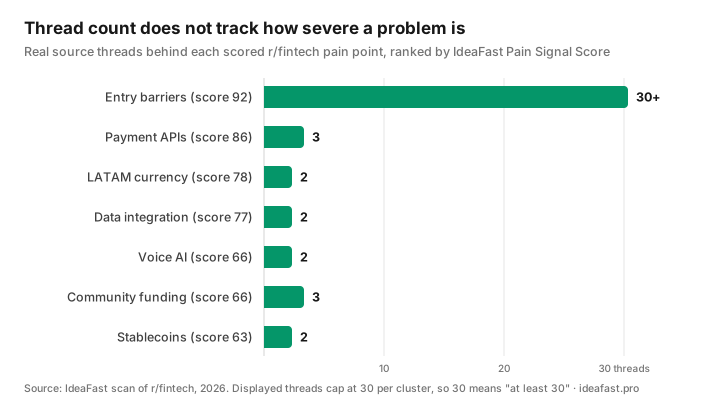
The gap between rows one and two above is the whole argument in one chart. "Entry barriers in fintech" and "Payment API reliability problems" score almost identically, 92 and 86, but one has at least 30 real threads behind it (30 is our data's display ceiling per cluster, so the true count may be higher) and the other has 3. Read only the raw post counts and you would rank them nowhere near each other. Read the actual specificity and severity of what people wrote, and they are nearly tied. The real threads behind that smaller cluster show why: short, specific, and clearly costly to the person posting, not a volume of low-effort complaints.
I thought a 63% Authorization rate was normal. I was wrong.
The payment API problems that only show up months later
Comments as a signal, not just a count
Awards are the clearest high-intent signal Reddit has, since spending real Reddit currency on a post is a stronger action than a free upvote, but they are rare enough that their absence tells you little. Comment depth is the more reliable everyday signal: a comment section with back-and-forth replies, not just top-level reactions, means the post triggered actual discussion rather than a scroll-past click.
Read the comments for tone, not just count them. A thread with 40 comments that are mostly "same here" or a single emoji is a weaker signal than a thread with 12 comments where people describe their own specific version of the problem, disagree with each other, or ask a genuine follow-up. The second thread is telling you something about the problem itself; the first is mostly telling you the post was relatable enough for a one-word reaction, which is a much lower bar.
Track engagement over time, not just per post
A single post's engagement rate tells you how that one post did on that one day. It does not tell you whether a topic, a subreddit, or a product category is gaining or losing attention, and that trend is usually more useful than any single data point. If you post about the same theme every few weeks, log the rate each time. A steady or rising rate across several posts on the same topic is a real signal that interest is growing. A single high-rate outlier is more often luck, timing, or the subreddit's front page having a quiet day, than a repeatable pattern.
The same logic applies to researching a community rather than posting to it. A subreddit where the top posts on a given problem keep climbing month over month is showing you rising real interest. A subreddit where one viral post explains almost all of the engagement on a topic, with nothing else coming close before or since, is more likely to be a one-off moment than a durable pattern, the kind of thing worth a second look before treating it as proof of ongoing demand.
Measuring your own posts versus researching a market
These are different jobs even though they use overlapping numbers. If you posted something and want to know how it did, engagement rate against your own impressions (from Reddit's native analytics, where available) is the honest number. If you are trying to understand what a whole community cares about, no single post's engagement rate tells you that, you need the pattern across many posts, which is a research problem, not a metrics-dashboard problem. We wrote about that side separately in how to analyze Reddit data for market research.
For research specifically, this is the problem IdeaFast is built to solve: instead of you eyeballing upvote counts across dozens of threads, it clusters the recurring complaints in a community, scores each cluster on frequency, specificity, and recency together, not vote count alone, and links every claim back to the real thread. An example of the difference that makes: pain points in r/fintech, where the top-scored problem has at least 30 real source threads behind it, not just a high vote count on one post.
Try it now
Find where your audience actually discusses this
See which subreddits are active for your topic before you decide where a post is worth measuring at all.
Frequently asked questions
What is a good Reddit engagement rate?
Above 1% is generally considered viral for that specific subreddit. 0.5% to 1% is strong performance, and 0.1% to 0.5% is typical for most posts. These are relative to the community's size and culture, not a fixed universal number.
How do you calculate Reddit engagement rate?
The standard formula is (upvotes + comments + saves) divided by impressions, times 100. When impressions are not visible (looking at someone else's post, for example), a usable proxy is (upvotes + comments) divided by the subreddit's subscriber count, times 100.
Are upvotes a reliable engagement metric on their own?
They measure quick agreement, not depth. A post with fewer upvotes but a long, active comment thread often represents stronger real engagement than a post with many upvotes and no discussion. Use vote count alongside comment depth, not instead of it.
Do Reddit awards matter for measuring engagement?
They are the strongest single high-intent signal Reddit has, since giving one costs real Reddit currency, but they are too rare to rely on as a primary metric. Treat them as a bonus confirmation, not a baseline you should expect.
How is measuring engagement different from researching market pain points?
Measuring engagement judges how one post performed. Market research looks for a pattern across many posts and many people, which a single post's engagement rate cannot show you. They use overlapping raw numbers but answer different questions.
Can you see impressions on someone else's Reddit post?
No. Impressions are only visible to the account that posted, through Reddit's own analytics. From the outside, you can only see upvotes, comments, and awards, which is why the subscriber-based engagement formula exists as a workaround.
Why does the same engagement rate mean different things in different subreddits?
Community size and culture both distort the raw numbers. Small, tight-knit subreddits tend to produce higher rates because a larger share of subscribers are genuinely active. Large general-purpose subreddits produce lower rates even for a strong post, because most subscribers never see it. Compare a post's rate to that specific subreddit's own typical performance, not to a universal number.
Should I track engagement rate for a single post or over time?
Both, but a single post tells you less than a trend. One high-rate post can be luck or timing. A steady or rising rate across several posts on the same topic, over weeks or months, is stronger evidence of real, growing interest than any single post's number.
Skip the manual digging
IdeaFast (ideafast.pro) checks the problem behind a startup idea against Reddit: it finds what people keep complaining about, scores each problem 0 to 100 and links every one to its threads. Pay once, no subscription. First scan free.
Start your free scan