Guide
SparkToro Review 2026: Pricing, Data and Who It Is For
SparkToro tells you where an audience spends time: subreddits, podcasts, websites, the words they search. Plans run free to $300 a month. What one report really costs, and the question it cannot answer.
By Shubham Bhatt · September 23, 2026 · 8 min read
Quick answer
SparkToro is audience research software: you describe an audience in a sentence and it reports where those people spend time, including the subreddits, podcasts, YouTube channels, websites and search terms they use. There is a free plan with 3 preview reports a month. Paid plans are Personal at $450 a year, which is the only plan with no monthly option, Business at $150 a month or $1,344 a year, and Agency at $300 a month or $2,700 a year. It tells you where your audience is. It does not tell you what they complain about, which is the next question if you are deciding what to build. Prices read from its pricing page on 23 September 2026.
IdeaFast reads a community’s recent posts and ranks the problems that keep coming up, with a link to every thread. Point it at your own niche. Your first scan is free.
Scan your niche$9.38 vs $0.90
Billed annually, one SparkToro report costs $9.38 on the entry Personal plan and $0.90 on Agency, ten times less, because the plans differ far more in report volume than in price. The cheapest paid plan is the most expensive way to buy a report.
What SparkToro is
SparkToro answers one question: where does a given audience actually spend its attention. You type something like "vegan home cooks who follow plant-based nutrition creators" and it returns a report on that group rather than on a single website.
It is a software company founded by Casey Henry and Rand Fishkin, based in Washington State, per its own About page. Rand co-founded Moz before this, which is why the tool shows up in so many SEO conversations.
A report covers demographics, the social accounts an audience follows, which networks they actually use, the websites they read, press and publications, podcasts, YouTube channels, the subreddits they subscribe to, the apps and AI tools they have adopted, the keywords they search, the words they use in their own bios, and, newer, the prompts they type into AI tools.
That last group is the useful part for most people: it turns "we should do content marketing" into a named list of places and phrases.
What is actually in a report
The report is one artefact with a dozen sections. It is worth knowing what each one is good for before you judge the price, because most people only ever use three or four of them.
| Section | What it shows | What it is good for |
|---|---|---|
| Demographics | Age, gender, seniority, company size, salary, location | Sanity-checking who you think your customer is |
| Social accounts | The creators and brands the audience follows and engages with | Partnerships, sponsorships, who to pitch |
| Social networks | Which networks they use more than average | Deciding which platform to stop posting on |
| Websites | The sites they read | Guest posts, ad placements, link targets |
| Press and publications | Publications they trust | A PR list you did not have to guess |
| Podcasts | Shows they listen to | Guest spots and sponsorships |
| YouTube | Channels with real audience overlap | Collaborations, ad targeting |
| Subreddits the audience subscribes to | Where to read what they say in their own words | |
| Apps and AI tools | Products they have adopted | Integrations, and positioning against what they already pay for |
| Search keywords | Terms they type into search | The spine of an SEO or paid search plan |
| Bio keywords | How they describe themselves | Their own words for your landing page |
| AI prompts | How they talk to AI tools | Newer, and the most interesting for positioning |
Two features sit above the data itself and only appear from the Business plan up: Take Action, which turns a report into marketing recommendations, and Persona Builder. If you are weighing Personal against Business, those two plus the jump from 4 reports to 25 are what you are paying for.
SparkToro pricing in 2026
| Plan | Price | Reports a month | Users | Notable |
|---|---|---|---|---|
| Free | $0 | 3 previews | 1 | Preview data only |
| Personal | $450 a year ($38/mo), no monthly option | 4 | 1 | All data types, custom logo, MCP access |
| Business | $150/mo, or $1,344 a year ($112/mo), saving $456 | 25 | 10 | Adds Take Action and Persona Builder |
| Agency | $300/mo, or $2,700 a year ($225/mo), saving $900 | 250 | 100 | Adds single sign-on, SCIM, pay by ACH or wire |
The free plan is a real plan, not a trial, but "preview data only" is doing a lot of work: SparkToro calls them previews rather than reports, so you see the shape of the results rather than the full lists. It is enough to judge whether the data knows your audience at all, which is the right thing to test first.
The entry plan is annual only
This is the part worth knowing before you get attached to the tool. Switch the pricing page to monthly billing and Personal has no price at all: it reads "Only available as an annual plan". The entry point into paid SparkToro is $450 up front for the year, not $50 to try a month. Business and Agency can still be bought month to month, at $150 and $300.
So the real ladder is: run free previews, then either commit $450 for a year on Personal or jump to $150 a month on Business. For a solo founder testing one idea, that is a different decision from the one most reviews describe.
What one report actually costs
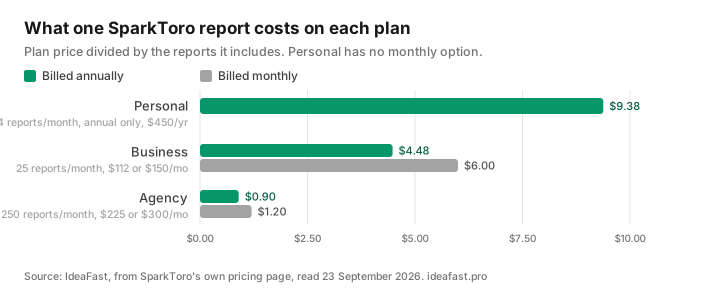
This is the number to decide on, because the plans are priced by volume, not by features. Personal gives you four reports a month for $450 a year, which works out at $9.38 a report. Business, billed annually, gives 25 for $112 a month, which is $4.48 each. Agency gives 250 for $225 a month, which is $0.90. Paying monthly instead of yearly costs about a third more per report on the two plans that allow it.
The practical rule: Personal only makes sense if four reports a month is genuinely your ceiling for a whole year. The moment you want a fifth, you are on a plan that costs twice as much per report as the one above it, having already paid for the year.
It also explains who SparkToro is really built for. Agencies run many audiences; a founder researching one product runs a handful of reports ever. The pricing is friendly to the first and indifferent to the second.
What SparkToro tells you, and what it does not
SparkToro is a map of attention. It is very good at where: which five subreddits, which podcasts, which newsletters, which search terms. If your problem is "I do not know where these people are", it answers that in one report.
It is not built to tell you what those people struggle with. A report will tell you your audience subscribes to r/smallbusiness. It will not tell you that the same complaint about chasing invoices comes up there every week, which is the thing you would build a product around.
The step after a SparkToro report
Once a report hands you subreddits, two questions decide whether they are worth your time: how much is actually written there, and what keeps coming up. The first is public. On 16 September 2026 we measured six business communities with the counters Reddit shows on every community page:
| Community | Weekly visitors | Posts and comments in a week |
|---|---|---|
| r/SaaS | 241,191 | 12,109 |
| r/smallbusiness | 323,580 | 11,348 |
| r/webdev | 382,161 | 5,076 |
| r/startups | 108,045 | 2,476 |
| r/Entrepreneur | 266,998 | 2,335 |
| r/marketing | 64,550 | 861 |
r/webdev has more weekly visitors than r/SaaS and less than half the writing. For finding problems, the second column is the one that matters, and you can check any community with our subreddit stats tool.
The second question, what keeps coming up, is what IdeaFast does: it reads a community, groups the complaints that repeat, scores each one and links the threads behind it. You can read the results for free, for example pain points in r/SaaS or r/smallbusiness, or browse the whole library. We are not an alternative to SparkToro and would not pretend to be; they answer different halves of the same question.
What you can check without paying anything
Some of what SparkToro sells is public if you are willing to do the work. Reddit publishes weekly visitor and contribution counts on every community page. Podcast charts are public. So is the search volume for a keyword, through Google's own Keyword Planner. What you cannot easily assemble by hand is the cross-channel picture: the same audience described across podcasts, subreddits, newsletters and search at once, ranked by how much they over-index.
That is the honest case for the tool. You are not buying facts you could never find; you are buying a day of work compressed into a report, and the confidence to say "here is where they are" in a meeting.
Is SparkToro worth it?
For a marketer choosing channels, usually yes, and the free plan is enough to test whether the data knows your audience. The alternative is guessing which podcast or subreddit matters, and one wrong sponsorship costs more than a year of Personal.
For a founder trying to decide what to build, it is the wrong first purchase. You are not short of places to look; you are short of a problem worth solving. Use the free plan to learn where your people are, then go and read what they write there.
For an agency, the maths is straightforward: at $1.20 a report the Agency plan is cheap per client, and the team features (users, single sign-on, SCIM) exist only at the top.
Frequently asked questions
What is SparkToro used for?
Finding where an audience spends its attention. You describe the audience and the report lists the social accounts they follow, the networks they use, the websites and publications they read, podcasts, YouTube channels, the subreddits they subscribe to, the apps and AI tools they use, and the terms they search.
How much does SparkToro cost?
There is a free plan with 3 preview reports a month. Personal is $450 a year for 4 reports a month and is sold annually only. Business is $150 a month, or $1,344 a year, for 25 reports. Agency is $300 a month, or $2,700 a year, for 250 reports. Read from its pricing page on 23 September 2026.
Is there a free version of SparkToro?
Yes, a free plan rather than a trial: 3 preview reports a month, one user, preview data only, so you see the shape of the results rather than the full lists.
Can I pay for SparkToro monthly?
Not on the entry plan. As of 23 September 2026 the Personal plan is sold annually only, at $450 a year. Business ($150) and Agency ($300) can be billed monthly, and both are cheaper per month if you pay for the year.
Who owns SparkToro?
It is an independent software company founded by Casey Henry and Rand Fishkin, based in Washington State, according to its own About page. Rand Fishkin co-founded Moz before SparkToro.
Does SparkToro show Reddit data?
Yes. Subreddit subscriptions are one of the data types in a report, so you get a ranked list of the communities an audience uses. It reports which communities they belong to, not what is discussed inside them.
Can I use SparkToro with ChatGPT or Claude?
Its pricing page lists MCP access on paid plans, which connects the tool to assistants such as ChatGPT, Claude or Cursor, and a separate pay-as-you-go API product.
What should I use to research what an audience complains about?
That is a different job from SparkToro's. Read the communities themselves, or use a tool that groups and scores recurring complaints, such as IdeaFast, which links every problem back to the threads it came from. Our guide on how to find pain points on Reddit explains the method by hand.
Sources
- SparkToro pricing page: Plan prices on both billing toggles, report allowances, user counts, annual savings, the annual-only Personal plan, feature differences and the note that the API is a separate product. Read 23 September 2026.
- SparkToro about page: Company ownership: founded by Casey Henry and Rand Fishkin, based in Washington State.
Skip the manual digging
IdeaFast scans Reddit for you and scores real pain points with evidence. Run your first scan free.
Start your free scan