Guide
Reddit Astroturfing: What SaaS Founders Should Actually Know (2026)
What Reddit astroturfing actually looks like, a real example caught in r/B2BSaaS, why it can be a federal violation now, and how to tell if the demand you're seeing on Reddit is real.
By Shubham Bhatt · August 10, 2026 · 10 min read
Quick answer
Astroturfing is paying for, faking, or coordinating Reddit posts, comments, or upvotes to look like organic community opinion. It fails on Reddit specifically because the platform's own users are unusually good at spotting it, and once spotted, they call it out publicly and permanently, screenshots do not disappear the way a deleted post does. Since October 2024, the FTC's Consumer Reviews and Testimonials Rule also makes some forms of it a federal violation, not just a Reddit rule-breaking problem, with real civil penalties attached.
IdeaFast reads a community’s recent posts and ranks the problems that keep coming up, with a link to every thread. Point it at your own niche. Your first scan is free.
Scan your niche2 of 5
In our own r/B2BSaaS research, 2 of the 5 real threads behind the community's top trust-related pain point are locals catching another SaaS company astroturfing the same subreddit, one of them by exposing the company's fake engagement strategy in public, in the exact community this article's readers are in.
Most astroturfing guides reach for the same handful of case studies, usually a consumer brand or a mobile game, because those are the ones that made the news. If you are a SaaS founder wondering whether it is worth the risk, the more useful example is not a game studio getting caught. It is another SaaS company getting caught, in the exact subreddit you are probably already reading.
It's already happening in the subreddits SaaS founders read
You do not have to go looking for a famous scandal to find astroturfing getting caught. It is happening in real time in the same communities where founders ask for advice.
Gojiberry is spamming with fake upvotes and stories
Biggest spammer on this sub exposing his fake engagement strategy himself
Both threads are from the same community: people naming a company directly, describing exactly what tipped them off, and doing it publicly where every future customer researching that company can find it. That is the actual cost. Not a removed post, a permanent, searchable, named callout sitting above the company's own marketing in search results for its own brand.
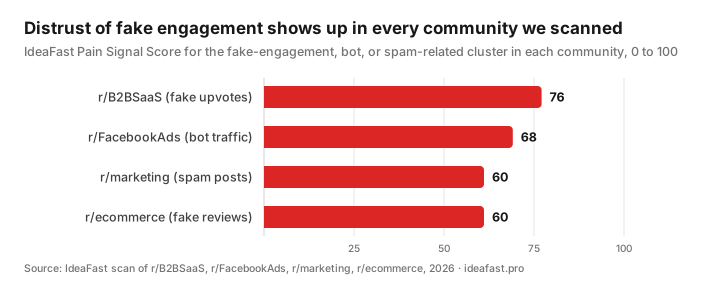
This is not unique to B2B SaaS. The same distrust shows up wherever a platform's incentives make fake signal cheap to produce. In r/ecommerce, sellers describe losing trust in an entire third-party review platform, not one bad actor on it, once they concluded the platform itself could not be trusted to police fake reviews.
Trustpilot isn't a review site, it's a protection racket for fake reviews
A near-identical pattern shows up in r/FacebookAds, where advertisers describe watching engagement numbers they know cannot be real people, and being unable to prove it or get a straight answer about it. "Are bots really a big problem?" and "How to block bots?" are both real, recent threads in that community. The common thread across all four communities is the same: people do not stay fooled for long, and once they stop trusting a signal, they say so publicly, permanently, and to an audience of exactly the buyers a company was trying to reach.
Why founders reach for it anyway, and why the math is worse than it looks
The appeal is straightforward: a real thread with genuine upvotes and comments looks like the cheapest, fastest form of social proof available, and paying for a manufactured version of it feels like buying a shortcut to the same result. What that reasoning misses is that the value of Reddit social proof comes almost entirely from its perceived authenticity. The moment a reader suspects it might be manufactured, even without proof, the same thread stops working as proof of anything, and if it later gets exposed, it becomes proof of the opposite: that the company was willing to fake its own reception.
There is also a scale problem specific to Reddit that does not exist on platforms with less community memory. A fake review on a product page mostly hurts the specific product page. A fake thread on Reddit gets discussed, cross-posted, and often lands in a dedicated subreddit built specifically to expose exactly this kind of thing, which means the exposure post can end up outranking the company's own marketing for its own brand name.
How communities actually catch it
None of the detection in the cases above involved sophisticated tooling. It was pattern-matching that any regular reader can do. The signals that keep coming up: an account with little or no history suddenly posting enthusiastically about one specific product, the same phrasing appearing across multiple "unrelated" posts or subreddits, comments that read like ad copy rather than how people actually talk about a product they use, and unusually tight timing, several "independent" positive posts appearing within hours of each other around a launch.
None of these signals prove astroturfing on their own, genuine enthusiasm can look coincidentally similar. But Reddit users tend to apply them collectively and publicly: someone raises a suspicion, others check the account histories themselves, and the thread either confirms it or moves on. That collective, visible verification process is exactly why the Trap Plan and Gojiberry cases above got caught by the community rather than by an internal audit.
The case study everyone cites, with the details that usually get left out
The astroturfing story that made real news in this space is Trap Plan, a game marketing agency that ran a campaign for the mobile game War Robots: Frontiers. Trap Plan created roughly 100 posts and comments across subreddits including r/pcmasterrace, r/PlayStation5, r/Mecha, and r/gaming, written to read as genuine player enthusiasm rather than marketing.
What actually exposed it was not Reddit's detection systems. Trap Plan itself published a case-study blog post bragging about how effectively it had pulled the campaign off. Redditors found that post, read exactly how the deception worked, and spread it. Trap Plan deleted the post once the backlash started, which did nothing, screenshots were already everywhere. The publisher, MY.GAMES, publicly distanced itself, saying the Reddit activity was the agency's own initiative and was never approved.
The lesson is not really about detection technology. It is that the people most likely to catch inauthentic content are the community itself, and once they do, the company that hired the agency eats the reputational damage regardless of who technically wrote the posts.
Since 2024, some of this is a federal violation, not just a Reddit problem
The FTC's Consumer Reviews and Testimonials Rule took effect on 21 October 2024. It prohibits, among other things, reviews or testimonials that misrepresent they come from a real person who actually used the product, insider reviews from employees or founders that do not disclose the connection, and buying or coordinating reviews written to hit a particular sentiment. Businesses can face real civil penalties for creating, buying, or spreading fake reviews, including ones generated by AI.
A Reddit post is not a formal "review" in every legal sense, but a coordinated campaign of fake accounts posing as satisfied users, describing a specific product experience they never had, sits close enough to what the rule targets that treating this as purely a Reddit ToS question undersells the actual risk.
The 2024 rule formalized enforcement of something the FTC had already signaled in its June 2023 update to the Endorsement Guides, which cover the broader category of endorsements and testimonials in advertising, including social media. The direction of travel across both is consistent: disclosure of a real connection to a business is treated as mandatory, not optional, and "nobody will notice" is not a defense that has held up.
What legitimate engagement looks like instead
Reddit's actual guideline for anyone with a stake in what they are posting is the 90/10 rule: no more than roughly one in ten of your posts or comments, across your account's whole history, should be self-promotional, and moderators in specific communities often enforce a stricter version of it. We wrote about that rule, and what happens to accounts that ignore it, in more detail in B2B lead generation on Reddit.
The honest version of the advice every astroturfing guide gives is simpler than it sounds: disclose who you are when it is relevant, answer the actual question someone asked instead of redirecting to a pitch, and accept that a slower, smaller, real audience beats a larger fake one that gets your company named in a callout thread.
What disclosure actually looks like in practice
- Say who you are up front if you are answering as the founder or an employee, a single sentence like "I built this, happy to answer honestly" does the work
- Answer the question asked before mentioning your product at all, if the product is not the direct answer, do not force it in
- Skip posts entirely in subreddits where your product is not genuinely relevant, a technically-true mention in the wrong community reads as spam even when it is not intended that way
- Never ask friends, employees, or contractors to post or upvote without disclosing their connection, this is exactly the pattern that got both Trap Plan and the r/B2BSaaS companies above caught
How to tell if the Reddit demand you're looking at is real
This cuts both ways. If you are researching a market on Reddit, not just posting to it, the same problem applies in reverse: a thread with a lot of upvotes and enthusiastic replies is not automatically real signal. Check the account histories of the most enthusiastic commenters, look for posts that repeat the same phrasing across different subreddits, and be skeptical of threads that read like a press release with the brand name changed.
This is also the reason every claim on this site links back to the original Reddit thread, so you can check it yourself instead of trusting a summary. An example of what verifiable evidence looks like in practice: pain points in r/B2BSaaS, including the two astroturfing callouts quoted above.
Try it now
Find where your real audience actually is
Before you consider paying for engagement, see which communities are already discussing your problem organically.
Frequently asked questions
What is Reddit astroturfing?
Paying for, faking, or coordinating Reddit posts, comments, or upvotes so they look like genuine, unprompted community opinion rather than marketing. It includes fake accounts posing as real users and undisclosed employee or founder posts pretending to be independent.
Is astroturfing on Reddit illegal?
It can be. Since October 2024, the FTC's Consumer Reviews and Testimonials Rule prohibits fake reviews and testimonials, including ones that misrepresent the poster as a genuine, uninvolved user. Coordinated fake-account campaigns can fall under this, with real civil penalties attached, on top of whatever Reddit itself does to the accounts and communities involved.
Does astroturfing actually get caught on Reddit?
Regularly, and often by the community itself rather than by Reddit's own systems. The most famous case, Trap Plan's War Robots: Frontiers campaign, was exposed because the marketing agency published its own case study bragging about the tactic. Smaller cases happen constantly in specific subreddits, including real examples found in r/B2BSaaS.
What happens to a company after it's caught astroturfing?
A permanent, public, searchable callout thread, often ranking alongside the company's own name in search results, plus account and sometimes subreddit-wide bans. Unlike a deleted marketing post, a callout thread does not go away, and it is usually found by exactly the future customers researching the company later.
What signals do Reddit users actually look for to spot astroturfing?
An account with little history suddenly posting enthusiastically about one product, identical or near-identical phrasing showing up across multiple posts or subreddits, comments that read like ad copy rather than how people normally describe using a product, and several "independent" positive posts appearing suspiciously close together around a launch.
Is it okay for a founder to post about their own product on Reddit?
Yes, as long as it is disclosed. Saying you built the product, answering the actual question asked rather than redirecting to a pitch, and staying within roughly a 90/10 ratio of non-promotional to promotional activity is treated very differently by both Reddit's communities and the FTC's rules than an undisclosed account posing as an independent user.
What is Reddit's 90/10 rule?
Reddit's actual self-promotion guideline: no more than roughly one in ten posts or comments from an account, across its whole history, should be self-promotional. It is enforced site-wide and, often more strictly, by individual subreddit moderators.
How can I tell if Reddit engagement on a topic is real?
Check the account history of enthusiastic commenters for a pattern of similar posts across unrelated subreddits, be skeptical of language that reads like marketing copy, and prefer threads where every claim can be traced back to a real, checkable post rather than taken on trust.
Skip the manual digging
IdeaFast (ideafast.pro) checks the problem behind a startup idea against Reddit: it finds what people keep complaining about, scores each problem 0 to 100 and links every one to its threads. Pay once, no subscription. First scan free.
Start your free scan