Guide
No-Code Problems in 2026: What 151 Reddit Posts Reveal
We analyzed 151 recent r/nocode posts. The problems no-code builders complain about most in 2026, and which tools draw the most fire.
By Shubham Bhatt · July 16, 2026 · 10 min read
Quick answer
Across 151 recent r/nocode posts, the problems that came up most were keeping AI-built apps working after launch, trust issues with platforms like Lovable and Bolt, the limits of vibe coding on a real product, and just picking a builder. The AI-building era has changed what no-code users struggle with.
The complaints in this post come from r/nocode. IdeaFast can run the same research on today’s posts, or on your own niche. Your first scan is free.
Scan r/nocode nowNo-code talk on Reddit moved fast this year. The old questions about drag-and-drop tools are still there, but most of the heat now sits around AI app builders: tools that generate a working app from a prompt, and everything that goes wrong after. We scanned r/nocode and clustered what people actually complain about. Here is what the data shows, with the original threads so you can read them yourself.
92
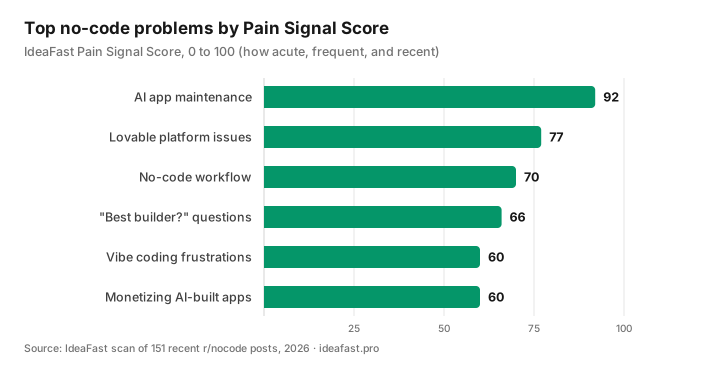
Keeping AI-built apps working after launch scored 92 out of 100 on our Pain Signal Score, the highest of any no-code problem across 151 recent r/nocode posts.
What do no-code builders complain about most?
The r/nocode community is now split between people shipping AI-generated apps and people who still build the traditional way, and the frustrations reflect that. Across the 151 posts, the 8 problems we scored sorted into a few clear clusters.
- Maintaining AI-built apps (the highest-scored): people ship something with an AI builder, then worry about keeping it working months later.
- Platform trust: named tools like Lovable and Bolt draw complaints about billing, reliability, and in one case a reported data exposure.
- Vibe coding limits: builders trying to 'vibe code' a real product and hitting a wall once it moves past a demo.
- Picking a builder: the single most-repeated question of all, some version of 'what is the best no-code builder', asked over and over.
- Monetizing and cost: turning an AI-built app into something that makes money, and replacing paid SaaS with self-hosted alternatives.
Which no-code tools get the most complaints?
The named tools that come up are almost all AI app builders, and each has its own recurring gripe. This is not a ranking of quality. It is a map of what people actually posted about, so you can read the specific threads before you commit your project to any one of them.
| Tool | What people use it for | Most common complaint on Reddit |
|---|---|---|
| Lovable | Prompt-to-app website and app builder | Billing disputes, a reported data exposure, and apps getting harder to maintain after months of use |
| Bolt | AI app builder | Reliability and outages, with users asking if others are hitting the same issues |
| Replit, Claude, Atoms | Generating a working app or site from a prompt | Confusion over which to pick, and output that looks generically AI-built |
| n8n + GPT | AI workflow and task automation | Powerful for automating operations, but people probe how far they can push it before it breaks |
One pattern cuts across the whole table: the complaint is rarely the initial build. It is what happens after. That is why the two tools with the most detailed threads, Lovable and the vibe-coding workflow in general, are worth looking at on their own.
Is Lovable safe to build on?
Lovable came up more than any other named tool, and not kindly. The complaints run from billing disputes to reliability, and one thread that drew attention reported a serious data exposure affecting projects built before a certain date. We are pointing at what people posted rather than confirming the claims, but the sheer volume tells you trust is the real issue here.
Lovable is robbing me.
9 months on Lovable ai website builder. The maintenance reality at month 9 nobody tells you about in the demos.
The worry underneath these threads is not one bug. It is dependence: your whole product lives inside a tool you do not control, so if it changes its pricing, breaks, or mishandles your data, your options are limited. That is what the top maintenance cluster is really about, and it is why the fear shows up again and again.
Can you actually vibe code a SaaS?
Vibe coding, letting an AI write most of the app while you steer with prompts, is the other big theme. The honest write-ups are the useful ones, because they come from people who tried it on a real product rather than a weekend toy. Two threads capture the arc: the early enthusiasm, and the wall that comes later.
I tried building a real MVP using some vibecoding tools and honestly, I'm just tired of it.
No, you can't vibe code a SaaS in a week. I tried. It was 3 months of hell.
The pattern in these is that AI builders get you to a demo fast and then slow down hard. The last stretch, edge cases, reliability, and maintenance, is where the time actually goes. If you are reading this to decide what to build, that gap is the opportunity, not the objection.
Why does everyone keep asking which builder is best?
The single most-repeated post in r/nocode is not a complaint at all. It is a question: some version of 'what is the best no-code builder', asked over and over by people about to start. We scored this as its own cluster because the volume is a signal in itself. The market is confused, and there is no default answer yet.
Which website builder is the easiest for beginners? Lovable? Atoms? Claude? Replit?
The answer the threads keep landing on is that it depends on what you are building, and that the smart move is to read recent complaints about a specific tool before committing. A builder that is great for a landing page can be the wrong call for an app with real data. Finding the exact community where people build your kind of project beats any one-size recommendation.
What should you build for no-code users?
The problems on this page point at a clear audience: non-technical people who shipped something with AI and now need help keeping it alive. The strongest gaps are maintenance, platform trust, and the jump from demo to real product. Mapped to the clusters above, a few build directions stand out.
- 1Maintenance and monitoring for AI-built apps: uptime checks, error alerts, and dependency warnings aimed at owners who cannot read the code themselves.
- 2A safety net for platform lock-in: export, backup, or migration tools for apps currently trapped inside a single builder.
- 3The demo-to-production gap: services that harden a vibe-coded MVP into something that survives real users and real data.
- 4Cost control: helping people untangle stacked SaaS subscriptions, an active thread in the community, without hand-rolling self-hosted replacements.
That is the useful way to read a page like this. Not as a list of complaints, but as a map of where an audience is actively looking for something better. The full 8 scored no-code problems show each one ranked by signal and linked to the threads behind it, and startup ideas for the no-code niche turns the same data into directions worth building.
How do you research no-code problems yourself?
Reading r/nocode directly beats any summary, because you see the exact words people use and how often a complaint repeats. To research a different audience the same way, start by finding the communities where they gather, then read their recent posts for the patterns that keep coming back.
Try it now
Find the community for your niche
Type a niche and get the subreddits where that audience actually posts, with links to real pain research where we have scanned them.
Frequently asked questions
What are the most common no-code problems in 2026?
Based on 151 recent r/nocode posts, the most discussed are keeping AI-built apps working after launch, trust issues with platforms like Lovable and Bolt, the limits of vibe coding on a real product, and choosing a builder in the first place. Maintenance of AI-built apps scored highest.
Is Lovable a good no-code tool?
It is one of the most-discussed tools on Reddit, and much of that discussion is critical: billing complaints, reliability, and one thread reporting a data exposure. Plenty of people still use it. The honest takeaway from the community is to know exactly what you are depending on before you build your whole product inside it.
What is vibe coding?
Vibe coding is building software by describing what you want to an AI and steering it with prompts, instead of writing the code yourself. It gets you to a working demo fast. The r/nocode threads from people who tried it on real products say the hard part is everything after the demo: edge cases, reliability, and maintenance.
Can you build a SaaS with no-code or vibe coding?
You can get to a working demo quickly. The Reddit threads from people who shipped real products say the hard part comes after: edge cases, reliability, and maintenance. It is doable, but the claims about doing it in a week do not survive contact with real users.
Why do AI-built apps break after launch?
This is the single highest-scored no-code problem right now. AI builders optimize for getting you to a working version quickly, not for long-term maintainability, so months later owners face dependencies they do not understand, platform changes they cannot control, and code they cannot easily fix themselves.
What is the best no-code app builder?
That exact question is the most-repeated one in r/nocode, and there is no single answer the community agrees on. It depends on what you are building. The more useful move is to read recent threads about the specific tool you are considering, since the complaints there are specific and current.
How did you find these no-code problems?
We scanned 151 recent posts from r/nocode, clustered the recurring complaints with an embedding pipeline, and scored each cluster by how frequent, specific, and recent it is. Every problem links back to the original threads, so you can verify it rather than trust a summary.
Skip the manual digging
IdeaFast (ideafast.pro) checks the problem behind a startup idea against Reddit: it finds what people keep complaining about, scores each problem 0 to 100 and links every one to its threads. Pay once, no subscription. First scan free.
Start your free scan