Guide
Small Business Problems: What 160 Reddit Posts Reveal
We analyzed 160 recent r/smallbusiness posts. The problems owners complain about most, ranked by Pain Signal Score, with the real threads behind each.
By Shubham Bhatt · August 8, 2026 · 10 min read
Quick answer
Across 160 recent r/smallbusiness posts, the problems that repeat most are following up on leads (not getting them), business debt, losing a client who was a big share of revenue, and compliance paperwork nobody has time for. The pattern underneath almost all of them is the same: the work that kills small businesses is administrative, not strategic.
The complaints in this post come from r/smallbusiness. IdeaFast can run the same research on today’s posts, or on your own niche. Your first scan is free.
Scan r/smallbusiness nowWe scanned 160 recent posts in r/smallbusiness, clustered the ones describing the same underlying problem, and scored each cluster by how acute, frequent, and recent it is. Here is what owners are actually struggling with, with the original threads so you can read them yourself rather than take our summary for it.
What do small business owners complain about most?
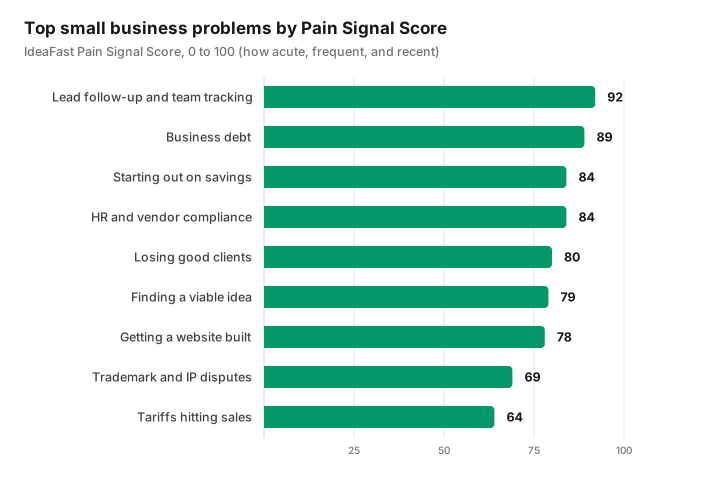
The thing that surprised us: almost nothing at the top is about strategy, competition, or product. It is admin. Chasing people who already said yes, tracking paperwork, keeping a client who is already paying you. The genuinely strategic worries (finding an idea, building a website) sit lower than the operational ones.
Why is following up harder than getting leads?
This is the highest-scoring problem in the whole scan, and the framing in the threads is consistent: getting the lead was never the bottleneck. What breaks is everything after it.
Anyone else feel like follow-up is harder than actually getting leads?
First time managing a crew, how do you keep track of everything?
What did you outsource that turned into babysitting?
Read those three together and a shape appears that no single post shows. These are not the same complaint, but they share a cause: there is no single place where anyone can see who is supposed to be doing what. The lead goes cold, the crew member is unmanaged, the outsourced help needs supervising, all because the owner is the only system.
What actually costs a small business its best clients?
Client retention is where the threads get genuinely painful to read, and the reasons are rarely the ones you would guess. Nobody in this cluster lost a client to a cheaper competitor.
Lost a client worth 30% of my revenue, then spotted him on Reddit DIY-ing the project
My 'favorite' client just sent me a 1-star review because I started charging for extra work
My best client referred me to their friend. That referral just cost me my best client
Three different owners, three different stories, one underlying exposure: revenue concentrated in a relationship rather than a system. The first one names the number, 30% of revenue in a single client. That is the actual risk being described across all three, and none of them saw it as a risk until it went.
How much of small business stress is money?
Business debt scores second overall, and it clusters with a quieter problem that shows up separately: not knowing what you actually earned.
Nobody prepares you for how unpredictable income feels when you're self employed
be honest. how much money did you actually make last month after ALL expenses. not revenue. actual money in your pocket.
29yo COO of $16M family business: profitable on paper but cash-flow negative and now behind on rent. What would you do?
That last one is the whole category in one sentence. A $16M business, profitable on paper, behind on rent. Revenue is not the number that keeps a small business alive, and the threads show owners at every size learning that the hard way. The debt conversations are downstream of this: people borrow to cover a gap they did not see coming.
What outside forces are hitting small businesses in 2026?
Two problems in the scan are not about how the business is run at all. They are things done to it, and the owners have no lever.
I've kept 200 people employed for years. A tariff might end that overnight.
A trademark troll filed a bad faith claim against my small fan merch store and Wix took my entire site down. 48+ hours later, still no response.
These score lower than the operational problems (64 and 69) and that ranking is honest: they hit fewer people. But they are worth reading precisely because they are the ones no amount of good management prevents. The second one is the more instructive of the two, because the damage came from the platform's response, not the claim.
The full list of what we found
| Problem | Who it hits | Score |
|---|---|---|
| Lead follow-up and team tracking | Agency owners and anyone managing a crew | 92 |
| Business debt | Owners borrowing to cover a cash-flow gap | 89 |
| Starting out on savings | People leaving a job to build something | 84 |
| HR and vendor compliance | Owners tracking documents and renewal dates | 84 |
| Losing good clients | Service businesses with concentrated revenue | 80 |
| Finding a viable idea | Aspiring owners before they start | 79 |
| Getting a website built | Owners choosing between platforms and freelancers | 78 |
| Trademark and IP disputes | Small brands facing bad-faith claims | 69 |
| Tariffs hitting sales | Anyone importing physical goods | 64 |
The full r/smallbusiness research page carries all fifteen, including the ones scoring at the floor, with every supporting thread linked. If you want the same treatment for a different community, browse the research database or run a scan yourself.
How do you research small business problems yourself?
You do not need a tool for this, just patience and a method. Read r/smallbusiness sorted by new, and write down complaints in the poster's own words rather than summarising them. Then search two of those exact phrases inside the subreddit. If the same complaint comes back written five different ways by five different people, you have found a pattern. If it does not, you found one person having a bad week.
That last step is the whole exercise, and it is the one most people skip. A single vivid post feels like a market because it is memorable, not because it is common. Everything above survived that test: each cluster is multiple different owners describing the same problem independently, which is why the threads are linked rather than paraphrased.
Try it now
Research a different audience
Type a niche and get the subreddits where those customers actually post, with links to real pain research where we have scanned them.
Frequently asked questions
What are the biggest problems small business owners face in 2026?
Based on 160 recent r/smallbusiness posts, the highest-scoring are lead follow-up and team tracking, business debt, starting out on personal savings, and HR and vendor compliance. The pattern is that operational and administrative problems outrank strategic ones: owners are more often sunk by chasing paperwork and people than by competition or product.
Why do small businesses lose their best clients?
Rarely to a cheaper competitor, based on these threads. The stories describe clients deciding to do the work themselves, reacting badly to being charged for scope that used to be free, and referral relationships going wrong. The underlying exposure is revenue concentrated in one relationship rather than spread across a system, and one owner names it directly at 30% of revenue in a single client.
What is the most common financial problem in a small business?
Cash flow rather than profit. The clearest example in the scan is a $16M family business that is profitable on paper but behind on rent. Debt conversations tend to be downstream of this: owners borrow to cover a gap they did not forecast, which is also why several threads are about not knowing what they actually earned after expenses.
Is r/smallbusiness a good place to research business problems?
Yes, and it is unusually candid. Owners post specific numbers, name what went wrong, and describe failures other channels would sanitise. It scanned at roughly 10.7 posts per distinct problem, meaning the discussion is varied rather than repetitive, which makes it a denser research target than the site median of 15.
How did you find these small business problems?
We scanned 160 recent r/smallbusiness posts, clustered the recurring complaints with an embedding pipeline so the maths decides which posts belong together, and scored each cluster by how acute, frequent, and recent it is. Every problem links back to the original threads, so you can verify it rather than trust a summary.
What should you build for small business owners?
The scan points at admin, not strategy. The top problem is not getting leads but following up on them, and it clusters with tracking a crew and supervising outsourced help. The common thread is the absence of one shared place showing who is doing what. That is a specific, repeated, unglamorous problem, which is usually the kind worth building for.
Where do small business owners discuss their problems online?
r/smallbusiness is the main Reddit community for it, alongside more specific ones like r/sweatystartup for service businesses and r/entrepreneur for earlier-stage questions. The advantage of Reddit over review sites or surveys is that people describe problems unprompted, in their own words, before anyone has asked them a leading question.
Skip the manual digging
IdeaFast (ideafast.pro) checks the problem behind a startup idea against Reddit: it finds what people keep complaining about, scores each problem 0 to 100 and links every one to its threads. Pay once, no subscription. First scan free.
Start your free scan