Guide
Entrepreneur Problems: What 152 Reddit Posts Reveal
We analyzed 152 recent r/Entrepreneur posts. The problems founders actually struggle with, ranked by Pain Signal Score, with the real threads behind each.
By Shubham Bhatt · August 8, 2026 · 10 min read
Quick answer
Across 152 recent r/Entrepreneur posts, the highest-scoring problem is regret about building before validating. But the more striking pattern is what sits underneath: six of the fourteen problems we scored are about the founder's state of mind, not the business's mechanics. Burnout, mental health, losing interest in something that works, and the aftermath of quitting a job all score higher than getting clients.
The complaints in this post come from r/Entrepreneur. IdeaFast can run the same research on today’s posts, or on your own niche. Your first scan is free.
Scan r/Entrepreneur nowWe scanned 152 recent posts in r/Entrepreneur, clustered the ones describing the same underlying problem, and scored each by how acute, frequent, and recent it is. We had just done the same for r/smallbusiness, and the contrast between the two turned out to be the most interesting thing in the data.
What do entrepreneurs complain about most?
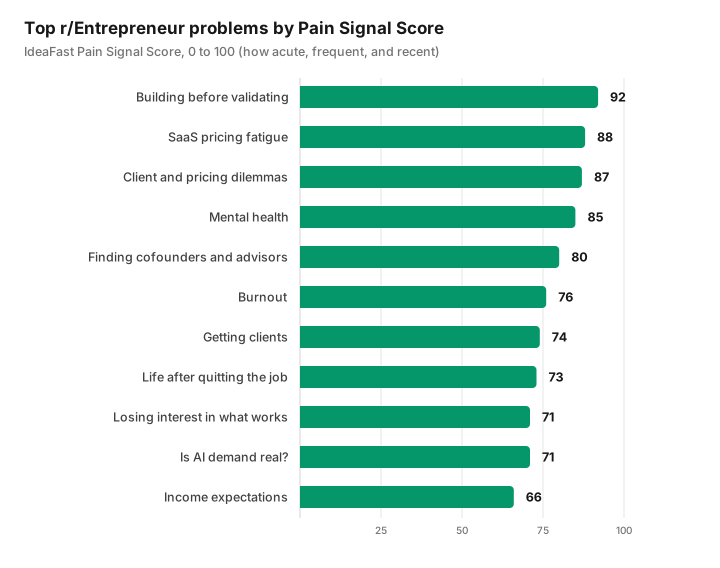
Compare that with what we found in r/smallbusiness, where the top of the list was almost entirely administrative: chasing leads, tracking a crew, compliance paperwork. Same research method, same week, completely different shape. r/smallbusiness worries about the work. r/Entrepreneur worries about itself.
Why is building before validating the top regret?
The highest-scoring cluster is not a problem people are having. It is a mistake they already made, described afterwards.
The most expensive mistake I made as a founder wasn't a bad product. It was building before I checked if anyone wanted it.
My friend stopped me from building and forced me to sell first. He was right, this is brutal
Both posts are written in hindsight, which is what makes them useful and also what makes them a warning. The advice to validate first is not new or contested. It is repeated constantly and still lands at the top of the list, because knowing it and doing it are different things. If you want the method rather than the regret, we wrote up how to validate a startup idea separately.
Is entrepreneurship bad for your mental health?
This is where the data genuinely surprised us. Mental health scores 85, above finding cofounders, above getting clients, above almost everything tactical.
The higher you go in life, the less anyone asks if you're okay.
I thought I wanted to be “rich”. Turns out, I just wanted freedom. Here's how I burned out building my business and what I'd do differently.
I dream of no longer being the CEO
None of those are from people whose business failed. That is the part worth sitting with. The burnout cluster is largely populated by founders whose businesses are working, which is a different problem from the one most startup advice addresses. Advice is abundant for growing revenue and thin for what to do when the thing you built stops being something you want.
What happens after you quit your job?
A separate cluster scoring 73 covers the gap between expecting freedom and getting it. The bluntest post in the entire scan lives here, and it is four words long.
This is fucking too hard.
I quit my $300k finance job at 30 because I finally admitted I hated it - and the lifestyle downgrade has been absolutely brutal.
I spent years saying “employment is better than being an entrepreneur.” The moment I get a job contract, I can't handle it and start preparing my resignation.
That third one is the whole cluster in miniature: someone who cannot do the job and cannot not do it. These posts get sympathy in the comments and very little practical help, which is roughly what you would expect, because the problem is not one a tool or a tactic solves.
What are founders unsure about commercially?
Not everything here is emotional. Two clusters are straightforwardly about money and market, and both are about doubt rather than difficulty.
the SaaS model is quietly falling apart for small businesses and nobody in tech wants to admit it
Is there real demand for “AI agents,” or is it mostly YouTube hype?
Both are people asking whether a category is real before committing to it, which is the same instinct as the top cluster, applied earlier. That is the healthier version of the pattern: the founders in the validation cluster asked afterwards, and these ones are asking first.
The full list of what we found
| Problem | What it is really about | Score |
|---|---|---|
| Building before validating | Regret, described in hindsight | 92 |
| SaaS pricing fatigue | Doubt about the subscription model itself | 88 |
| Client and pricing dilemmas | What to charge and who to turn down | 87 |
| Mental health | Isolation as the business grows | 85 |
| Finding cofounders and advisors | Where competent partners actually are | 80 |
| Burnout | Often among founders whose businesses work | 76 |
| Getting clients | First and repeat customer acquisition | 74 |
| Life after quitting the job | Expectation versus reality of freedom | 73 |
| Losing interest in what works | Disengagement from a functioning business | 71 |
| Is AI demand real? | Whether a hyped category has buyers | 71 |
| Income expectations | How people actually reach a target number | 66 |
The full r/Entrepreneur research page carries all fourteen with every supporting thread linked, and startup ideas for indie hackers turns adjacent data into directions worth building.
What should you build for entrepreneurs?
Honestly: be careful here. This is the audience most likely to be building the tool themselves, and the top problems are the ones software is worst at. Nothing ships that fixes burnout or isolation.
The buildable clusters are the commercial ones lower down the list, not the emotional ones at the top. Score tells you what hurts, not what sells, and this scan is the clearest example of that gap we have published. A problem can be acute, frequent, recent, and still not be a business, which is exactly why we link every thread instead of just handing over a ranked list.
How do you research entrepreneur problems yourself?
Read r/Entrepreneur sorted by new, and write complaints down in the poster's own words rather than summarising them. Then search two of those exact phrases inside the subreddit. If the same thing comes back written five different ways by five different people, it is a pattern. If not, you found one person having a hard week. Everything above survived that test, which is why the threads are linked rather than paraphrased.
Try it now
Research a different audience
Type a niche and get the subreddits where those customers actually post, with links to real pain research where we have scanned them.
Frequently asked questions
What problems do entrepreneurs face most in 2026?
Based on 152 recent r/Entrepreneur posts, the highest-scoring is regret about building before validating demand, followed by doubt about the SaaS pricing model, client and pricing dilemmas, and mental health. Six of the fourteen problems we scored are psychological rather than operational, which is the clearest pattern in the data.
Is entrepreneurship bad for mental health?
The threads suggest it is at least isolating. Mental health scored 85 out of 100 in our scan, above finding cofounders and above getting clients. The notable detail is that the burnout cluster is largely populated by founders whose businesses are working, not failing, which is a different problem from the one most startup advice addresses.
Why do founders regret building before validating?
Because the cost is only visible afterwards. The posts in this cluster are written in hindsight, by people who already spent the months. The advice itself is not new or contested, which is what makes it the top-scoring problem: it is repeated constantly and still gets skipped, because knowing it and doing it are different things.
How is r/Entrepreneur different from r/smallbusiness?
We scanned both in the same week with the same method, and the shapes are completely different. r/smallbusiness is dominated by administrative problems: lead follow-up, tracking a crew, compliance paperwork. r/Entrepreneur is dominated by psychological ones: burnout, isolation, losing interest, the aftermath of quitting a job. One community worries about the work, the other worries about itself.
What should you build for the entrepreneur audience?
Be cautious. This audience is unusually likely to build the tool themselves, and its highest-scoring problems are ones software cannot solve. The buildable opportunities are the commercial clusters lower down (pricing decisions, client acquisition, evaluating whether a category has real demand) rather than the emotional ones at the top. A high pain score tells you what hurts, not what sells.
How did you find these entrepreneur problems?
We scanned 152 recent r/Entrepreneur posts, clustered recurring complaints with an embedding pipeline so the maths decides which posts belong together, and scored each cluster by how acute, frequent, and recent it is. Every problem links back to the original threads so you can verify it rather than trust a summary.
Where do entrepreneurs discuss their problems online?
r/Entrepreneur is the largest general Reddit community for it, with r/smallbusiness covering owner-operators, r/indiehackers covering solo software founders, and r/startups covering funded and scaling companies. The value of Reddit over surveys is that people describe problems unprompted, before anyone asks them a leading question.
Skip the manual digging
IdeaFast (ideafast.pro) checks the problem behind a startup idea against Reddit: it finds what people keep complaining about, scores each problem 0 to 100 and links every one to its threads. Pay once, no subscription. First scan free.
Start your free scan