Guide
Ecommerce Problems: What 149 Reddit Posts Reveal
We analyzed 149 recent r/ecommerce posts. The problems sellers complain about most, ranked by Pain Signal Score, with the real threads behind each.
By Shubham Bhatt · August 8, 2026 · 10 min read
Quick answer
Across 149 recent r/ecommerce posts, nine of the fifteen problems we scored are money leaving the business through a channel the seller does not control: counterfeits, returns postage, chargebacks reversed by banks, platform subscription fees, rising supplier and 3PL costs, and customs charges customers refuse to pay. The top-scoring problem is someone else selling a copy of your product.
The complaints in this post come from r/ecommerce. IdeaFast can run the same research on today’s posts, or on your own niche. Your first scan is free.
Scan r/ecommerce nowWe scanned 149 recent posts in r/ecommerce, clustered the ones describing the same underlying problem, and scored each by how acute, frequent, and recent it is. This is the third community we have done this week, and it produced the clearest single pattern of the three.
What do ecommerce sellers complain about most?
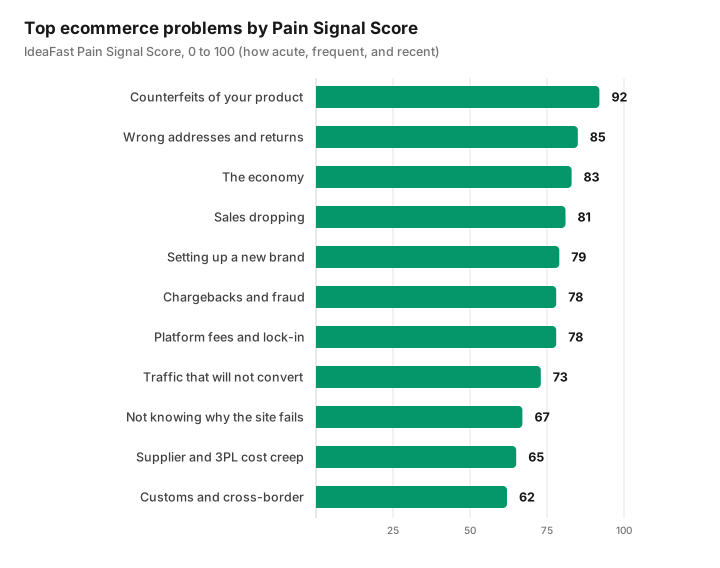
One seller names the pattern better than we could, in a post about something else entirely:
Revenue leakage is doing a number on our numbers quietly and I am not sure where to even start fixing it
That is the shape of almost this entire list. Compare it with the other two communities we scanned the same week: r/smallbusiness worries about admin, r/Entrepreneur worries about itself, and r/ecommerce worries about money quietly going out a side door.
Why are chargebacks so painful for small stores?
Chargebacks score 78 and the threads are unusually raw, because the loss is not just money, it is money taken back after the work was already done.
Just got charged back $3,400 in one day and I literally want to throw my laptop out the window.
Banks keep approving chargebacks even when Im 100% in the right wtf
Chargebacks are honestly the one part of e-commerce I wasn't prepared for
The second quote is the one that matters. The complaint is not that fraud happens, it is that the seller loses even when they are right, because the decision sits with a bank they have no relationship with. We looked at this problem in detail from the merchant side in Shopify chargebacks.
Is everyone's sales down or is it just me?
Two clusters, the economy at 83 and sales decline at 81, are really one conversation: sellers checking whether what they are seeing is their fault.
Sales down over 50% from last year; am I the only one?
Running a small ecommerce business right now feels way heavier than it looks
Notice the question mark in the first one. A striking share of this cluster is not asking for a fix, it is asking for confirmation that the drop is external. That is a real and underserved need: a seller with no benchmark cannot tell a market-wide decline from their own mistake, and the two call for opposite responses.
Why are sellers frustrated with Shopify?
Platform dissatisfaction ties for sixth at 78, and the complaint is consistent enough to be quotable almost verbatim across threads: the platform is fine, the stack of subscriptions on top of it is not.
Starting a Shopify store and realizing EVERYTHING is a subscription is actually insane 😭
Getting tired of Shopify POS fees, what are people using instead?
This is the same leakage pattern in a different costume. Nobody in these threads says Shopify does not work; they say the per-app, per-month cost of making it work is not visible until you are already committed. Our separate scan of r/Shopify itself shows merchants further along the same curve.
Why is traffic not converting?
The conversion cluster scores 73, and its quotes are the most specific numbers in the whole scan.
4,000 sessions. 15 orders. What the f*ck are we doing wrong?
spent $12K on a product photoshoot. got worse conversion rates... got any ideas???
$12,000 spent on a fix that made the metric worse. That is the cluster in one line, and it connects directly to the next-lowest problem on the list, not knowing why the site fails at 67. These sellers are not short of effort or budget. They are short of diagnosis, spending real money on guesses because nothing tells them where the drop-off actually is.
The full list of what we found
| Problem | Where the money goes | Score |
|---|---|---|
| Counterfeits of your product | To someone selling a copy of what you made | 92 |
| Wrong addresses and returns | Postage, twice, plus the refund argument | 85 |
| The economy | Demand you cannot influence | 83 |
| Sales dropping | Same, but personal and unexplained | 81 |
| Setting up a new brand | MOQs and sourcing decisions made blind | 79 |
| Chargebacks and fraud | Back to the buyer, decided by a bank | 78 |
| Platform fees and lock-in | Per-app, per-month, invisible until committed | 78 |
| Traffic that will not convert | Ad spend against a funnel nobody can diagnose | 73 |
| Not knowing why the site fails | Guesses, at $12K a time | 67 |
| Supplier and 3PL cost creep | Small increases nobody notices in time | 65 |
| Customs and cross-border | Parcels refused over fees at the door | 62 |
The full r/ecommerce research page carries all fifteen with every thread linked, and startup ideas for ecommerce sellers turns the same data into directions worth building.
What should you build for ecommerce sellers?
This is a far better build target than the other two communities we scanned, for one reason: the problems are financial and measurable, so a fix has an obvious dollar value. A seller losing $3,400 to a chargeback or bleeding margin to supplier creep can tell instantly whether your product paid for itself. That is a much easier sale than a tool for burnout.
The clearest gap in the data is diagnosis, not execution. Two separate clusters (conversion frustration at 73, not knowing why the site fails at 67) describe people spending real money on guesses. Nothing in these threads suggests they lack effort or budget. They lack a way to see where the leak is before they spend against it.
How do you research ecommerce problems yourself?
Read r/ecommerce sorted by new and write complaints down in the seller's own words, not summarised. Then search two of those exact phrases inside the subreddit. If the same complaint comes back written five different ways by five different people, it is a pattern worth taking seriously. If it does not, you found one person having an expensive week. Everything above cleared that bar, which is why every claim links to its threads.
Try it now
Research a different audience
Type a niche and get the subreddits where those customers actually post, with links to real pain research where we have scanned them.
Frequently asked questions
What are the biggest problems in ecommerce right now?
Based on 149 recent r/ecommerce posts, the highest-scoring are counterfeits of your own product, wrong addresses and returns, the wider economy, and sales dropping without explanation. Nine of the fifteen problems we scored are money leaving the business through a channel the seller does not control, which is the clearest pattern in the data.
Why do banks side with customers on chargebacks?
Sellers in these threads report losing disputes even with full documentation, and the structural reason is that the decision sits with the buyer's issuing bank rather than any party the seller has a relationship with. That is why the complaint is rarely about fraud existing and usually about being unable to win when clearly in the right.
Are ecommerce sales down for everyone in 2026?
We cannot answer that from a Reddit scan, and it is worth being clear about the limit. What the data does show is that a striking share of the sales-decline cluster is asking for confirmation rather than advice: sellers want to know whether a drop is market-wide or their own fault, because the two call for opposite responses and most have no benchmark to tell them apart.
Is Shopify worth it for a small store?
The complaints in this scan are not that Shopify fails, but that the per-app, per-month subscription stack needed to make it work is not visible until you are committed. If you are evaluating it, price the whole stack you will realistically need rather than the base plan, since that gap is what the threads consistently describe.
What should you build for ecommerce sellers?
Diagnosis rather than execution. Two separate clusters, conversion frustration and not knowing why the site fails, describe sellers spending real money on guesses (one spent $12,000 on a photoshoot that made conversion worse). These are financial, measurable problems, which makes them a far better build target than communities whose top problems are emotional.
How did you find these ecommerce problems?
We scanned 149 recent r/ecommerce posts, clustered the recurring complaints with an embedding pipeline so the maths decides which posts belong together, and scored each cluster by how acute, frequent, and recent it is. Every problem links back to the original threads so you can verify it rather than trust a summary.
Where do ecommerce sellers discuss problems online?
r/ecommerce is the main general community, with r/shopify for platform-specific issues, r/Etsy for marketplace sellers, and r/dropship for that model specifically. Reddit is useful here because sellers post real numbers, sessions, order counts, and chargeback amounts, in a way they rarely do publicly elsewhere.
Skip the manual digging
IdeaFast (ideafast.pro) checks the problem behind a startup idea against Reddit: it finds what people keep complaining about, scores each problem 0 to 100 and links every one to its threads. Pay once, no subscription. First scan free.
Start your free scan