Guide
SEO Problems: What 152 Reddit Posts Reveal
We analyzed 152 recent r/SEO posts. The problems practitioners complain about most, ranked by Pain Signal Score, with the real threads behind each.
By Shubham Bhatt · August 8, 2026 · 10 min read
Quick answer
Across 152 recent r/SEO posts, every one of the top problems is a question nobody can answer with confidence: why traffic dropped, why a page will not index, whether backlinks still work, what Google will do next. The highest-scoring cluster is traffic collapsing for reasons the owner cannot identify. SEO's defining pain is not difficulty, it is attribution.
The complaints in this post come from r/SEO. IdeaFast can run the same research on today’s posts, or on your own niche. Your first scan is free.
Scan r/SEO nowWe scanned 152 recent posts in r/SEO, clustered the ones describing the same underlying problem, and scored each by how acute, frequent, and recent it is. This is the fourth community we have run this week, and it is the first where the top of the list is made almost entirely of questions rather than complaints.
What do SEOs complain about most?
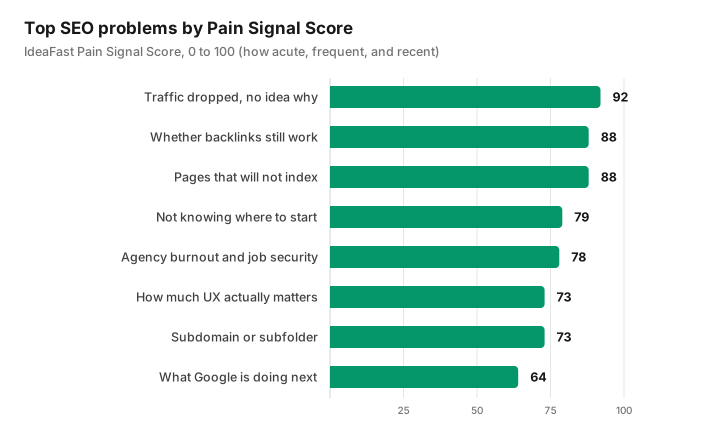
Read the titles in these threads and the pattern is hard to miss. They end in question marks. Compare that with the other communities we scanned this week: r/smallbusiness is administrative, r/Entrepreneur is psychological, r/ecommerce is financial. r/SEO is epistemic. The work is not hard to do. It is hard to know whether what you did worked.
Why did my traffic drop?
The top cluster, scoring 92, is the same post written over and over by different people, and the shared feature is that none of them can tell cause from coincidence.
Google Traffic Collapse. Am I screwed?
My traffic dropped 70% after the GSC July Update
Impressions dropping as clicks increase, almost 40% CTR, why might this happen?
That last one is the most interesting, because the numbers are *good*. Clicks up, CTR at 40%, and the poster still cannot tell whether something is wrong. When you cannot explain a good outcome either, you do not have a measurement problem, you have an attribution problem. This is the same gap we found in r/ecommerce, where sellers spend real money against funnels nobody can diagnose.
Why will my pages not index?
Indexing ties for second at 88, and these threads have a particular flavour: people doing everything correctly and getting inconsistent answers from Google's own tooling.
Google Search Console says URL is live, then says it's not indexed after refresh. Why?
I noindexed my ‘crawled but not indexed' pages. Did I overreact?
We can vouch for that second one, because we ran SEO on this site into the identical question this month: a handful of pages sitting in "Crawled, currently not indexed", and no way to tell a quality judgment from a queue. The honest answer, which nobody in that thread quite gives, is that the status usually means "not yet" rather than "no", and reacting to it by noindexing pages removes your only evidence that it might resolve.
Do backlinks still work?
The backlink cluster carries 12 separate threads, the second-densest evidence in this scan, and it is not really one question. It is the same doubt approached from a dozen angles.
How Is This Possible? High DR but no Banklinks
I need to place 25 free Backlinks weekly or i am getting fired
Those two posts side by side are the whole state of the practice. One person cannot work out why a site ranks without links; another has a weekly link quota attached to their employment. The tactic is simultaneously unexplainable and mandatory, which is exactly what a field looks like when its causal model has stopped matching reality.
Is AI going to replace SEO jobs?
Four separate clusters touch job security: agency burnout at 78, plus three more at our publish floor covering AI job impact, role relevance, and AI's effect on sales. Together they are the largest theme in the scan by cluster count.
Am I going to lose my job? Bossman discovered AI
Agency life for a decade. So burnt out.
This is the one theme r/SEO shares with r/Entrepreneur, where six of fourteen problems were psychological. The difference is the cause. Founders burn out from carrying a business alone; SEOs burn out from being measured on outcomes they cannot control, which is the attribution problem again, arriving as a performance review.
The full list of what we found
| Problem | The question underneath it | Score |
|---|---|---|
| Traffic dropped, no idea why | Was that me, Google, or the market? | 92 |
| Whether backlinks still work | Is the main tactic still causal? | 88 |
| Pages that will not index | Is this a judgment or a queue? | 88 |
| Not knowing where to start | What actually matters first? | 79 |
| Agency burnout and job security | Does this job survive AI? | 78 |
| How much UX actually matters | Is UX a ranking factor or folklore? | 73 |
| Subdomain or subfolder | Which structure costs me less? | 73 |
| What Google is doing next | Can I plan against this at all? | 64 |
One number worth calling out separately: the beginner-questions cluster carries 22 separate threads, the densest evidence of any cluster in this scan. The single most common thing happening in r/SEO is somebody asking where to start, which tells you something about how legible the field currently is to newcomers. The full r/SEO research page carries all fourteen problems with every thread linked.
What should you build for SEOs?
Be careful here, more than with the other communities we have scanned. The obvious answer, a tool, runs straight into a saturated market defended by Ahrefs and Semrush, and one of our floor-scoring clusters is people actively cancelling those subscriptions and complaining about how hard it was to cancel. This audience is sophisticated, price-sensitive, and churns loudly.
The real gap is the one the whole scan describes: nothing tells an SEO why something changed. Rank trackers report what happened; nobody reliably separates an algorithm update from a competitor's move from your own deployment. That is a genuinely hard problem, which is why it is unsolved, and a genuinely valuable one for the same reason. It is also the same shape as the diagnosis gap in ecommerce, which suggests the pattern generalises beyond one audience.
How do you research SEO problems yourself?
Read r/SEO sorted by new and write complaints down in the poster's own words rather than summarising them. Then search two of those exact phrases inside the subreddit. If the same thing comes back written five different ways by five different people, it is a pattern. If not, you found one person having a bad update. Everything above cleared that bar, which is why every claim links to its threads.
Try it now
Research a different audience
Type a niche and get the subreddits where those customers actually post, with links to real pain research where we have scanned them.
Frequently asked questions
What are the biggest SEO problems in 2026?
Based on 152 recent r/SEO posts, the highest-scoring are unexplained traffic drops, doubt about whether backlinks still work, and pages that will not index. What unites the top of the list is that every one is a question rather than a task: the difficulty is not doing SEO, it is knowing whether what you did caused what happened.
Why did my website traffic drop suddenly?
The honest answer from these threads is that most people never find out. Posts describe drops after algorithm updates, after technical changes, and after nothing identifiable at all. One poster reports clicks increasing and impressions falling with a 40% CTR and still cannot tell whether something is wrong, which suggests the problem is attribution rather than measurement.
What does 'Crawled - currently not indexed' actually mean?
It usually means not yet rather than no, and the threads show people struggling to tell those apart. We hit the same status on this site's own pages this month. The practical risk is overreacting: one poster noindexed their affected pages and then asked whether that was a mistake, which it generally is, since it removes your evidence that the situation might resolve on its own.
Do backlinks still matter for SEO?
The community cannot agree, and that disagreement is itself the finding. This cluster carries 12 separate threads ranging from people unable to explain sites ranking without backlinks to someone whose job depends on placing 25 links a week. The tactic is treated as simultaneously unexplainable and mandatory, which is what happens when a field's causal model stops matching what it observes.
Is AI replacing SEO jobs?
Four separate clusters in this scan touch job security, making it the largest theme by cluster count. The posts mix real anxiety with burnout that predates AI. The distinctive detail is that SEOs describe being measured on outcomes they cannot control, so the job-security worry and the attribution problem are the same underlying issue arriving in different forms.
What should you build for the SEO audience?
Approach with caution: the tooling market is dominated by Ahrefs and Semrush, and one cluster in this scan is people cancelling those subscriptions and complaining about the cancellation process. The genuine unsolved gap is attribution, reliably separating an algorithm update from a competitor's move from your own change. It is hard, which is why it is open.
How did you find these SEO problems?
We scanned 152 recent r/SEO posts, clustered the recurring complaints with an embedding pipeline so the maths decides which posts belong together, and scored each cluster by how acute, frequent, and recent it is. Every problem links back to the original threads so you can verify it rather than trust a summary.
Skip the manual digging
IdeaFast (ideafast.pro) checks the problem behind a startup idea against Reddit: it finds what people keep complaining about, scores each problem 0 to 100 and links every one to its threads. Pay once, no subscription. First scan free.
Start your free scan